VRD Studio

Category: Uncategorized

  • Untitled post 320

    Estimated reading time: 7 minutes
    Categories: B2B Acquisition, ERP Sales Strategy, Pipeline Automation

    Meta description: Diagnose where ERP sales velocity is lost and recover it through earlier education, stronger qualification, executive sponsorship and CRM discipline.

    Long ERP sales cycles are often treated as an unavoidable consequence of selling complex software.

    That assumption is expensive.

    Enterprise buyers do need time to evaluate operational risk, compare options, secure internal approval and plan implementation. But the length of the cycle is not simply a personality trait of the buyer. It is an operational metric shaped by the acquisition system around them.

    When a R500k+ ERP opportunity takes nine months to close, the relevant question is not only, “Why are they moving so slowly?”

    It is:

    At which stage did the opportunity stop progressing, and what friction allowed it to remain there?

    For ERP and CRM implementation firms, sales velocity is recovered by diagnosing those friction points early:

    • Education arrives too late.
    • Qualification is handled manually and inconsistently.
    • The business case is built after the sales conversation begins.
    • Executive sponsorship is discovered only near the end.
    • Sales, marketing and delivery teams operate through disconnected handoffs.

    Each problem creates delay. Together, they create a pipeline that appears active but produces revenue too slowly.

    Sales velocity is a measurable operating outcome

    A common sales velocity model is:

    Qualified opportunities × average deal value × win rate ÷ sales-cycle length

    The formula matters because it shows the commercial effect of time.

    If deal value and win rate remain stable, reducing the average sales cycle increases the rate at which pipeline becomes revenue. The objective is not to pressure buyers into artificial urgency. It is to remove unnecessary waiting, repetition and uncertainty from the buying process.

    For an ERP implementation firm, useful velocity metrics include:

    • Average days from first response to qualified opportunity.
    • Average days between discovery and technical evaluation.
    • Average time spent waiting for business-case approval.
    • Percentage of opportunities with an identified economic buyer.
    • Percentage with a scheduled next step.
    • Time between sales acceptance and implementation handoff.
    • Stage conversion rates by source and campaign.

    This turns “ERP deals take a long time” into a diagnosable statement.

    A pipeline review should reveal whether the constraint sits in acquisition, qualification, executive alignment, procurement or handoff.

    Senior business leaders watching an operational briefing and ROI dashboard in an executive meeting room

    Velocity is often lost before the first sales conversation

    The first source of delay is frequently late education.

    Many implementation firms rely on a prospect to complete most of the strategic work independently. The buyer sees an advertisement, submits an enquiry, books a demonstration and only then begins learning:

    • Why the current system is creating operational cost.
    • Which business outcomes an ERP programme should improve.
    • How the investment might be evaluated.
    • Who needs to participate in the decision.
    • What implementation risk needs to be controlled.

    That sequence places too much educational responsibility on the sales representative.

    The result is a first meeting that starts at the beginning. The rep must explain the category, diagnose the problem, establish urgency, introduce the implementation approach and identify stakeholders: all before the opportunity has earned serious internal attention.

    Strategic education changes the starting point.

    An Automated Executive Briefing can explain the commercial and operational logic of an ERP initiative before a representative becomes involved. It should not attempt to replace discovery or provide a generic product tour. Its role is to help senior decision-makers understand:

    • The cost of maintaining fragmented processes.
    • The operational symptoms that indicate system limitations.
    • The financial logic behind modernisation.
    • The risks of delaying a decision.
    • The internal roles required for a successful programme.

    When the prospect reaches a sales conversation, they are not merely asking, “What does the software do?”

    They are better positioned to discuss, “Is this the right response to our operational problem, and what would a viable business case require?”

    That is a material improvement in velocity.

    VRDStudio builds Automated B2B Acquisition Systems that use targeted B2B traffic and executive education to pre-sell the ROI logic of complex software implementations. The objective is to move informed, relevant buyers into the CRM: not to maximise raw enquiry volume.

    Qualification should reduce uncertainty, not add another meeting

    The next friction point is manual qualification.

    A form submission or content download is not a sales opportunity. It is an indication of interest. Treating every indication as an opportunity creates false pipeline and consumes senior sales capacity.

    Qualification should establish whether the initiative has enough substance to progress. The exact framework may differ by firm, but the operating questions should cover:

    • What operational problem is driving the investigation?
    • Is there an active project or only general research?
    • Which business functions are affected?
    • What is the expected investment range?
    • Who owns the commercial decision?
    • What is the required decision or implementation window?
    • Which stakeholders must approve the change?
    • What happens if the organisation does nothing?

    The important point is timing.

    These questions should be answered progressively through the acquisition experience, not collected from scratch by the account executive in the first meeting. An executive briefing, structured form and CRM workflow can capture the initial context before a rep commits time.

    This does not mean automating judgement. It means reserving human judgement for opportunities that have demonstrated a credible business problem, a decision path and a reason to act.

    The CRM should distinguish clearly between:

    • Engaged contact: consumed content or responded to an advertisement.
    • Marketing-qualified account: matches the target profile and shows relevant intent.
    • Sales-accepted opportunity: has a defined problem and agreed next step.
    • Qualified opportunity: has sufficient commercial, operational and stakeholder information to forecast.

    Without these distinctions, pipeline velocity is obscured by records that should never have entered the forecast.

    Technical fit cannot carry the business case alone

    ERP sales cycles also slow when technical evaluation begins before the commercial case is clear.

    A product demonstration can confirm that a platform has the required modules, integrations or workflows. It cannot, by itself, secure investment approval.

    If the opportunity is framed primarily around features, the evaluation may continue indefinitely. Different departments request additional demonstrations. New use cases are added. Technical questions multiply. The buying committee becomes larger without becoming more aligned.

    Velocity is recovered when technical evaluation is connected to defined business outcomes.

    Before a demonstration or proof of concept, the buyer and seller should agree on:

    • The operational processes being assessed.
    • The specific outcomes that matter.
    • The evidence required to confirm fit.
    • The stakeholders responsible for each evaluation area.
    • The date by which the assessment should be complete.
    • The decision that follows a successful evaluation.

    This prevents the technical stage from becoming an open-ended research exercise.

    Educational content supports this by introducing the business-case logic before detailed product evaluation. The prospect can then assess functionality against a commercial objective: such as improving planning accuracy, reducing manual reconciliation or increasing management visibility: rather than treating the software as a collection of features.

    Executive sponsorship must be developed before the final approval

    One of the most damaging delays occurs when the sales team discovers too late that its primary contact cannot secure approval.

    A project may have a committed operational champion, a positive technical assessment and a detailed proposal. Yet the deal stalls because the economic buyer has not accepted the business case or the initiative has not been given executive priority.

    This is not necessarily a failure of the champion. A major ERP purchase requires a narrative that can travel through the organisation:

    • Why change is required now.
    • What business risk is being reduced.
    • What measurable improvement is expected.
    • What investment and internal capacity are required.
    • How implementation will be governed.
    • What the cost of inaction looks like.

    That narrative should begin before the proposal stage.

    Executive-level educational content gives senior stakeholders a reason to enter the conversation earlier. It also gives the internal champion language they can use when discussing the initiative with a CEO, CFO, COO or board-level group.

    The account executive still needs to validate the business case with customer-specific data. But the foundational logic should not be created from a blank page during late-stage negotiations.

    A mutual action plan can then convert intent into accountable progress, with owners and dates for:

    • Data collection.
    • Business-case development.
    • Executive review.
    • Security and procurement.
    • Contract approval.
    • Implementation planning.

    The plan is not administrative decoration. It is a control mechanism for the sales cycle.

    Sales operations leaders reviewing a CRM pipeline with qualification checkpoints and stage progression

    Handoff gaps quietly reset the sales cycle

    Velocity can also be lost after a prospect has already agreed to move forward.

    Weak handoffs force people to repeat work. Marketing passes incomplete context to sales. Sales closes the deal without documenting the assumptions behind the solution. Delivery begins by rediscovering the customer’s objectives, stakeholders and constraints.

    For the buyer, this creates uncertainty at precisely the point when confidence should be increasing. Scope questions reopen. Commitments are clarified again. The implementation start date moves.

    A disciplined CRM handoff should include:

    • The original business problem.
    • Agreed commercial and operational outcomes.
    • Modules, phases and integrations included.
    • Key stakeholders and executive sponsor.
    • Decision criteria.
    • Risks or constraints identified during evaluation.
    • Commitments made during the sales process.
    • Confirmed implementation kickoff date.

    The implementation kickoff should be planned before signature wherever possible. This demonstrates operational readiness and prevents the period between contract and delivery from becoming another unmanaged gap.

    The goal is continuity: the customer should feel that the same business case is moving forward, not that one internal team has finished and another is starting over.

    Recover velocity by designing the acquisition system around friction

    Improving ERP sales velocity is not about demanding that buyers decide faster. It is about making the decision easier to progress.

    The strongest acquisition systems address friction before it reaches the sales team:

    1. Target the right accounts through focused B2B acquisition rather than broad traffic.
    2. Educate senior stakeholders early with an executive briefing built around business outcomes.
    3. Capture qualification context automatically before assigning expensive sales capacity.
    4. Connect technical evaluation to a measurable business case.
    5. Create executive sponsorship before final approval.
    6. Track every stage in the CRM with clear entry and exit criteria.
    7. Transfer commercial and operational context into implementation without loss.

    This approach does not eliminate the legitimate complexity of an ERP purchase. It removes avoidable complexity from the path.

    For firms implementing Sage, SAP, Syspro or Acumatica, sales-cycle length should be managed like any other operational metric. Measure it by stage. Identify the repeated delays. Build content, automation and process controls around the constraint.

    When education, qualification and business-case framing happen earlier, the sales representative enters a more mature conversation. The buyer is better prepared, the decision path is clearer and executive involvement is less likely to arrive as a late-stage surprise.

    That is where velocity is recovered.

    Ready to improve ERP sales velocity?

    Ready to stop wasting your top reps' time on unqualified demos? Visit VRDStudio to learn more.

  • Untitled post 318

    Estimated reading time: 8 minutes
    Categories: B2B Acquisition, ERP Sales Strategy, Pipeline Automation
    Meta description: Learn how ERP firms can calculate the ROI of automated acquisition using rep capacity, sales-cycle length, close rate, and deal value.

    Following the case for acquisition systems and the anatomy of how they work, this third article addresses the question an operations-focused Managing Director or Sales Director will eventually ask:

    What is the financial return of replacing our lead-generation model with an Automated B2B Acquisition System?

    The answer does not begin with lead volume.

    It begins with the economic value of senior sales capacity.

    The unit of value is the senior sales hour

    A generic lead is not an economic outcome. It only becomes valuable when it progresses into a qualified opportunity, receives the right technical attention, and eventually closes.

    For an ERP or CRM implementation firm, every unqualified demo consumes more than calendar time:

    • A senior sales representative prepares for and attends the meeting.
    • A solution architect may be pulled into technical discussions.
    • Management reviews an opportunity that should never have entered the pipeline.
    • A qualified deal may be delayed because senior capacity is occupied elsewhere.
    • Forecasts become less reliable as weak opportunities remain active.

    The real unit of value is therefore the qualified opportunity cost per senior sales hour.

    A two-hour demo with a prospect that lacks budget, authority, urgency, or operational fit is not free. Its cost is the loaded cost of the people involved, plus the value of the qualified opportunity that could have received that time.

    Build the model from operational inputs

    An MD can calculate the baseline using a small number of inputs.

    Input What to measure
    Senior rep loaded cost per hour Salary, benefits, incentives, and employment overhead
    Unqualified demo hours Preparation, meetings, follow-up, and internal coordination
    Average sales-cycle length From qualified opportunity to signed agreement
    Close rate Closed deals divided by qualified opportunities
    Average deal value Implementation revenue, excluding assumptions that do not belong in the model
    Rep capacity Productive selling hours and qualified opportunities each rep can handle
    System TCO Implementation, integration, management, data, and ongoing operating costs

    Use these formulas:

    Annual wasted-hour cost =
    Number of reps × unqualified demo hours per month × 12 × loaded hourly cost
    
    Annual closed revenue =
    Qualified opportunities × close rate × average deal value
    
    ROI =
    (Economic gain from the system − system TCO) ÷ system TCO
    

    Economic gain should include both:

    • Incremental gross profit from additional or earlier closed deals
    • Recovered senior capacity that can be redirected toward qualified opportunities

    Do not treat every recovered hour as immediate cash savings. In most firms, the first benefit is additional capacity, not a reduction in payroll.

    What changes when education is automated?

    An ERP prospect often needs substantial education before a productive sales conversation can occur.

    They need to understand:

    • Why their current systems are limiting growth or control
    • Which operational problems the proposed platform can solve
    • What implementation involves
    • Whether the expected return justifies the investment
    • Who needs to participate in the decision
    • Whether the project is urgent enough to fund

    If a senior rep delivers this education manually to every new lead, the sales team becomes the top of the acquisition process.

    An Automated B2B Acquisition System moves much of that early education into an on-demand Executive Briefing. The prospect can consume the relevant information before booking time with the sales team.

    VRDStudio builds these systems around:

    • Targeted B2B traffic from LinkedIn and Google
    • Automated Executive Briefings
    • Pre-qualification logic
    • CRM integration
    • Structured progression and rejection data

    The purpose is not to remove the sales conversation. It is to make the conversation occur later, when the prospect is better informed and more commercially relevant.

    Senior ERP sales and technical leaders discussing a structured executive briefing with a qualified prospect

    Value lever one: rep-hour reallocation

    Start with the hours currently lost to low-probability activity.

    Suppose a firm has:

    • Six senior sales representatives
    • 18 hours per month per rep spent on unqualified demos and related follow-up
    • A loaded senior rep cost of R850 per hour
    • A 40% reduction in unqualified demo activity

    The recovered capacity is:

    6 reps × 18 hours × 12 months × 40%
    = 518.4 senior hours recovered per year
    

    The associated capacity value is:

    518.4 hours × R850
    = R440,640 per year
    

    That R440,640 is not necessarily a payroll saving. It is the value of time that can be redirected to:

    • Better-fit opportunities
    • Commercial and stakeholder alignment
    • Solution design for active deals
    • Proposal quality
    • Closing activity
    • Strategic account development

    The next step is to determine how many additional qualified opportunities those hours can support.

    Additional opportunity capacity =
    Recovered productive hours ÷ senior hours required per opportunity
    

    This is more useful than reporting a lower cost per lead. It connects automation directly to rep capacity.

    Value lever two: shorter sales cycles

    Enterprise sales cycles create a throughput constraint.

    If an ERP implementation takes 12 months to progress from qualified opportunity to signed agreement, a rep can only move a limited number of opportunities through the process at any one time.

    If the system helps compress the cycle to approximately seven months, the theoretical throughput improvement is:

    12 ÷ 7 = 1.71
    

    That does not mean revenue automatically increases by 71%. Client decision processes, procurement, implementation capacity, and market demand still create constraints.

    Use the cycle reduction as a planning factor, then apply a conservative operational cap. For example:

    • Baseline cycle: 12 months
    • New cycle: approximately seven months
    • Effective annual throughput improvement used in the model: 20%

    The cash-flow effect should also be separated from the revenue effect.

    A deal closed five months earlier is not necessarily worth more in total contract value. It is worth more in timing:

    • Earlier invoicing
    • Earlier cash collection
    • Earlier implementation mobilisation
    • More capacity to start the next opportunity
    • Less revenue pushed into a future reporting period

    A finance team can model this separately using actual invoicing terms and gross margins.

    Operations executive reviewing a shorter opportunity timeline and pipeline throughput plan on a large digital display

    Value lever three: higher close rates

    Better qualification should improve close rate, but only if the qualification logic is based on commercial reality.

    Useful qualification signals include:

    • A defined operational problem
    • A credible implementation timeline
    • Budget ownership or access to budget
    • Executive involvement
    • A clear fit with the firm’s ERP or CRM expertise
    • Engagement with the Executive Briefing
    • Agreement to the next commercial step

    A system that simply produces more form completions will not improve economics. A system that filters for decision readiness can.

    For the model, compare the baseline close rate with the post-system close rate.

    Example:

    • Baseline close rate: 20%
    • Target close rate: 23%
    • Relative improvement: 15%

    The increase may appear small. On R500,000 implementations, it is not small when applied across a properly constrained pipeline.

    Value lever four: better forecasting and management visibility

    Forecasting value is harder to express than rep-hour savings, but it is measurable.

    A structured acquisition system records more than a contact and a meeting. It can show:

    • Which prospects completed the Executive Briefing
    • Which qualification criteria were met
    • Where prospects exited
    • Why opportunities were rejected
    • How long each stage took
    • Which channels produced qualified opportunities
    • Which opportunities progressed to commercial review

    This gives management a cleaner distinction between:

    • Traffic
    • Engaged accounts
    • Qualified opportunities
    • Sales accepted opportunities
    • Proposals
    • Closed revenue
    • Structured rejection

    A minimum value calculation can include reduced pipeline administration.

    For example:

    • Six reps
    • Four hours per month each spent manually reviewing and cleaning pipeline data
    • 50% reduction through structured CRM data
    • R850 loaded hourly cost
    6 × 4 × 12 × 50% × R850
    = R122,400 in recovered capacity
    

    The larger benefit is avoiding bad decisions:

    • Overstaffing for weak demand
    • Pulling solution architects into low-probability deals
    • Forecasting revenue that is not decision-ready
    • Ignoring segments that produce higher-quality opportunities
    • Allowing stalled opportunities to remain artificially active

    Illustrative financial example

    The following is an illustrative planning model, not a forecast or performance guarantee.

    Assume an ERP implementation firm has:

    • Six senior sales representatives
    • Average deal value of R500,000
    • 12 closed deals per year
    • Baseline close rate of 20%
    • Baseline sales cycle of 12 months
    • R850 loaded senior rep cost per hour
    • 18 unqualified demo hours per rep per month
    • 40% reduction in unqualified demo activity
    • 10% additional qualified opportunity capacity from rep-hour reallocation
    • 20% effective throughput improvement from cycle compression
    • Close rate increasing from 20% to 23%
    • First-year system TCO of R480,000 for internal business-case purposes
    • 35% gross margin used to value incremental implementation revenue

    Baseline

    12 deals × R500,000
    = R6,000,000 annual revenue
    

    Reallocated rep capacity

    6 × 18 × 12 × 40% × R850
    = R440,640 recovered capacity value
    

    Combined operating effect

    Apply the three commercial factors to the baseline number of closed deals:

    12 deals × 1.10 × 1.20 × (23% ÷ 20%)
    = 18.2 equivalent closed deals
    

    Rounded to a practical planning figure, this is approximately 18 deals.

    18 deals × R500,000
    = R9,000,000 annual revenue
    

    The illustrative revenue difference is approximately:

    R9,000,000 − R6,000,000
    = R3,000,000 incremental revenue
    

    Value the incremental revenue at the assumed 35% gross margin:

    R3,000,000 × 35%
    = R1,050,000 incremental gross profit
    

    Add the recovered senior capacity:

    R1,050,000 + R440,640
    = R1,490,640 total economic gain
    

    Finally:

    (R1,490,640 − R480,000) ÷ R480,000
    = 210% illustrative ROI
    

    This model deliberately does not assume that the full theoretical 12-to-seven-month throughput ratio becomes revenue. It applies a 20% effective throughput factor to account for real-world constraints.

    The purpose is to give management a disciplined way to test its own numbers.

    Sales director and managing director reviewing CRM stages, rejection reasons, win rates, and forecast bands in a modern enterprise office

    The management decision

    The question is not whether an Automated B2B Acquisition System can produce more activity.

    The question is whether it can improve the economics of your existing sales capacity.

    Measure the system against:

    • Cost per qualified opportunity
    • Unqualified demo hours per rep
    • Qualified opportunities per rep
    • Sales-cycle length
    • Close rate by channel
    • Gross profit per senior sales hour
    • Forecast accuracy
    • Revenue recognised earlier through cycle compression

    If those metrics improve, the system is doing operational work. It is educating prospects before the first meeting, filtering out poor-fit demand, improving decision readiness, and placing better opportunities into the CRM.

    That is the economic difference between generating leads and building a pre-qualified discovery pipeline.

    Ready to model your acquisition economics?

    Ready to stop wasting your top reps' time on unqualified demos? Register for our free webinar, “The Death of the Free ERP Demo,” available at 10:00 AM EST and 4:00 PM SAST, at VRDStudio or visit VRDStudio to learn more.

  • Untitled post 316

    Estimated reading time: 8 minutes
    Categories: B2B Acquisition, ERP Sales Strategy, Pipeline Automation
    Meta description: Learn how to build an Automated B2B Acquisition System that qualifies ERP buyers, integrates with your CRM, and improves sales performance over time.

    For an ERP or CRM implementation firm, acquisition is not a collection of disconnected marketing activities.

    It is an operating system for creating qualified pipeline.

    That distinction matters when your team sells R500k+ implementations for Sage, SAP, Syspro, or Acumatica. Your sales capacity is limited, the buying process is complex, and every poorly qualified opportunity consumes senior technical and commercial resources.

    An Automated B2B Acquisition System connects four components into one continuously improving operating layer:

    1. Targeted B2B traffic
    2. Automated Executive Briefings
    3. Qualification logic
    4. CRM integration

    The traffic creates market access. The briefing educates the buyer. The qualification layer decides what happens next. The CRM records the outcome and feeds the next decision.

    The result is not simply more activity. It is a self-correcting machine for producing better opportunities and shortening enterprise sales cycles.

    The four components work as one system

    Technical illustration showing targeted B2B traffic, executive briefings, qualification logic and CRM integration connected in a self-correcting loop

    1. Targeted B2B traffic

    Traffic is the input layer.

    For an ERP implementation firm, this should not mean maximising clicks or generating broad awareness. It means placing a specific commercial problem in front of a defined group of decision-makers.

    Typical targeting variables include:

    • Job role: CEO, Managing Director, CFO, COO, or Operations Director
    • Company size and operating complexity
    • Industry and distribution model
    • Existing ERP or CRM environment
    • Geographic market
    • Known business triggers, such as expansion, acquisition, compliance pressure, or operational inefficiency
    • Implementation value and buying capacity

    LinkedIn and Google can play different roles:

    • LinkedIn provides account and role-level targeting.
    • Google captures active demand when executives are researching systems, implementation partners, or operational problems.

    The important point is that traffic is controlled by the qualification model. If your best customers are mid-market manufacturers with multi-site operations, the system should not allocate equal attention to small firms with limited implementation capacity.

    Traffic must be measured against downstream value, not surface engagement.

    2. Automated Executive Briefings

    An Automated Executive Briefing is the education layer.

    It gives a senior prospect enough commercial and operational context to decide whether a serious conversation is justified. The objective is not to entertain the viewer or explain every feature of an ERP platform.

    The briefing should address questions such as:

    • What operational problem is creating financial or management risk?
    • Why has the current system stopped supporting the business?
    • What does the implementation process involve?
    • What should the buyer evaluate before selecting a platform or partner?
    • What level of investment, internal capacity, and executive involvement is required?
    • Which organisations are not suitable for the proposed solution?

    A strong briefing pre-sells the logic of the engagement before a sales representative becomes involved.

    It should also capture decision signals, including:

    • Which sections were watched
    • Whether the prospect returned to the briefing
    • Which commercial topics received attention
    • Whether the prospect completed a qualification step
    • Whether the prospect requested a conversation
    • Whether multiple stakeholders engaged

    This is why a briefing is more than a video asset. It is a controlled information and intent-capture environment.

    VRDStudio's Briefing Hub demonstrates the underlying principle: structured information reduces ambiguity before a project or commercial conversation moves forward.

    3. Qualification logic is the differentiator

    Traffic and video can be purchased or produced by almost any competent team.

    The qualification-logic layer is what turns those activities into a system.

    Qualification logic defines:

    • Who should be routed to sales
    • Who should be nurtured
    • Who should be excluded
    • What information must be collected
    • Which signals increase or decrease priority
    • What action should occur at each decision point

    The criteria should come from your own commercial history: not generic frameworks copied from a marketing template.

    Start with closed-won and closed-lost analysis

    Review a meaningful sample of recent opportunities and identify patterns across:

    • Company size
    • Industry
    • Number of users or operating sites
    • Existing platform
    • Executive involvement
    • Budget range
    • Business problem
    • Buying timeline
    • Implementation readiness
    • Sales-cycle length
    • Reason for winning
    • Reason for losing
    • Reason for disqualification

    Separate correlations from assumptions.

    For example, you may discover that your most profitable projects share the following characteristics:

    • More than 100 employees
    • Multiple branches or warehouses
    • A clear operational deadline
    • Executive ownership of the decision
    • An existing system that cannot support reporting or integration requirements
    • A budget aligned with a full implementation

    You may also find that opportunities are routinely lost when:

    • The prospect is only comparing software prices
    • No executive sponsor is involved
    • The implementation is treated as an IT-only project
    • The budget is below your minimum viable engagement
    • The prospect expects a demonstration before defining the business case

    Those findings become system rules.

    Express criteria as explicit routing rules

    Avoid vague instructions such as “prioritise high-quality leads.”

    Write rules that can be executed consistently:

    • If the company matches the target industry and has more than 100 employees, then add fit priority.
    • If the prospect indicates a business-critical deadline within six months, then increase urgency priority.
    • If a CEO or Managing Director completes the executive briefing and requests a conversation, then route to the senior sales queue.
    • If the stated budget is below the implementation threshold, then move to nurture or disqualify.
    • If no decision-maker is involved, then request stakeholder confirmation before assigning a sales task.
    • If the prospect is an existing customer or active opportunity, then suppress from acquisition routing.

    This makes the system measurable. Management can review whether the rules are producing the desired pipeline rather than relying on individual sales judgement at the top of the process.

    4. CRM integration turns activity into intelligence

    Sales operations manager and ERP implementation director analysing CRM qualification scores, routing rules and pipeline outcomes

    The CRM should not function as a contact address book.

    It should function as the system’s operational memory and learning engine.

    Every record should contain enough information to explain:

    • Where the opportunity originated
    • Which account and role engaged
    • What problem the prospect identified
    • Which briefing content they consumed
    • How they were qualified
    • Why they were routed to a specific rep
    • What happened after the meeting
    • Why the opportunity progressed, stalled, or was rejected
    • What commercial value was attached to the opportunity

    Useful CRM fields may include:

    • Acquisition source and campaign
    • Target account segment
    • Platform or current system
    • Company size and industry
    • Business trigger
    • Budget range
    • Decision-maker status
    • Implementation timeframe
    • Qualification score
    • Routing outcome
    • Rejection reason
    • No-show reason
    • Closed-lost reason
    • Expected implementation value
    • Sales-cycle duration

    The rejection data is especially important.

    “Not interested” is not a useful operational category. A better system distinguishes between:

    • No budget
    • Wrong company profile
    • No executive sponsor
    • No active business problem
    • Timing deferred
    • Existing platform retained
    • Competitor selected
    • Implementation complexity underestimated
    • Project outside delivery capability

    This allows management to see where the system is failing.

    For example:

    • High engagement but low qualification may indicate inaccurate targeting.
    • High qualification but low meeting attendance may indicate weak routing or poor expectation-setting.
    • Strong meetings but low progression may indicate that the briefing is not addressing commercial objections.
    • Strong progression but excessive cycle length may indicate missing stakeholder or implementation-readiness criteria.

    The CRM does not merely report the pipeline. It explains the pipeline.

    The self-correcting feedback loop

    The operating loop should work like this:

    1. Traffic reaches a defined account segment.
    2. Prospects consume or interact with an Executive Briefing.
    3. Qualification rules interpret fit, intent, authority, timing, and readiness.
    4. The CRM routes, nurtures, suppresses, or assigns the opportunity.
    5. Sales records progression and rejection data.
    6. Management reviews the outcomes.
    7. Targeting, briefing content, and qualification rules are adjusted.
    8. The next cycle operates with better information.

    This is the central “aha”:

    The system improves because it captures decision data at every stage: not because it sends more messages or produces more content.

    Over time, the best acquisition system becomes more selective. It learns who not to send to sales, which business triggers matter, which sources produce revenue, and what information senior buyers require before a serious conversation.

    The operating cadence

    An Automated B2B Acquisition System should be managed like a commercial operating process, not launched like a once-off campaign.

    A practical monthly review should cover three areas.

    Stage progression

    Review conversion and leakage between:

    • Target account reached
    • Briefing started
    • Briefing completed
    • Qualification submitted
    • Opportunity accepted
    • Meeting attended
    • Discovery completed
    • Proposal issued
    • Closed won or lost

    Look for the first stage where performance drops materially.

    That is usually where the operating issue exists.

    Traffic-source value

    Measure sources against commercial outcomes:

    • Qualified opportunities per source
    • Accepted opportunities per source
    • Pipeline value per source
    • Closed-won value per source
    • Average sales-cycle length
    • Cost per accepted opportunity
    • Rejection rate by segment

    A source that generates fewer leads but more accepted opportunities may be more valuable than a source producing large volumes of low-intent contacts.

    Qualification-rule performance

    Review whether the rules are predicting sales value accurately.

    Ask:

    • Which rules correlate with progression?
    • Which criteria are generating false positives?
    • Which good opportunities are being rejected too early?
    • Which rejection reasons are increasing?
    • Are the thresholds still aligned with rep capacity?
    • Are reps receiving enough context to act quickly?

    Rules should change when evidence changes. That is how the system compounds.

    Senior ERP and CRM leaders conducting a monthly pipeline review using stage conversion and traffic-source performance data

    Build around rep capacity and sales-cycle compression

    The system should be designed around the number of quality opportunities your sales team can process: not the maximum number of leads your advertising budget can buy.

    Define capacity using:

    • Number of senior reps
    • Available discovery hours per month
    • Average time required per opportunity
    • Technical resources required for solution design
    • Maximum active opportunities per rep
    • Target proposal volume
    • Acceptable sales-cycle duration

    Then set routing thresholds accordingly.

    If your team can properly handle 20 new qualified opportunities per month, the system should not send 80 weak opportunities into the CRM. That creates administrative load, slows follow-up, and reduces attention on genuine buying situations.

    The same architecture should support sales-cycle compression.

    This requires capturing the information sales normally gathers during early meetings:

    • Current operational environment
    • Business impact
    • Required outcomes
    • Stakeholders
    • Timing
    • Budget expectations
    • Implementation constraints
    • Decision process

    When this context is available before the first serious sales conversation, the rep can focus on diagnosis and commercial alignment instead of repeating basic education.

    The practical blueprint

    For an ERP or CRM implementation firm, the architecture can be summarised as follows:

    • Targeted traffic controls who enters the system.
    • Automated Executive Briefings establish context and capture intent.
    • Qualification logic determines whether the opportunity deserves sales capacity.
    • CRM integration records the complete decision path.
    • Management review converts outcomes into better rules, content, and targeting.

    VRDStudio builds Automated B2B Acquisition Systems for high-ticket software implementers, including firms working with Sage, SAP, Acumatica, and Syspro.

    The objective is not to create a larger database.

    It is to create a more intelligent acquisition operation: one that protects senior rep capacity, routes budget-ready executives into the right process, and improves every month through real commercial data.

    Ready to build the operating layer?

    Ready to stop wasting your top reps' time on unqualified demos? Register for our free webinar “The Death of the Free ERP Demo” — available at 10:00 AM EST and 4:00 PM SAST — at VRDStudio or visit VRDStudio to learn more.

  • Untitled post 314

    Meta description: Learn why ERP firms should replace lead-volume marketing with acquisition systems that compress sales cycles, qualify buyers, and protect senior sales capacity.

    Reading time: 7 minutes
    Categories: B2B Acquisition · ERP Sales Strategy · Pipeline Automation

    Most ERP firms do not have a lead problem.

    They have a sales-capacity problem.

    Senior salespeople, solution architects, and founders have limited hours available for discovery, process mapping, commercial discussions, and executive alignment. When every new enquiry is treated as a sales opportunity, those scarce hours are consumed by prospects who are not ready, not suitable, or not funded for a serious implementation.

    That creates a misleading result:

    • Lead volume increases.
    • Sales activity increases.
    • Calendar pressure increases.
    • Qualified pipeline does not increase at the same rate.
    • Enterprise sales cycles become harder to control.

    For firms selling R500k+ Sage, SAP, Syspro, or Acumatica implementations, the objective should not be to generate more names.

    The objective should be to compress the distance between initial attention and a commercially serious conversation.

    That requires an acquisition system.

    Lead generation creates work. Acquisition systems create throughput.

    Conventional lead generation is usually measured at the top of the funnel:

    • How many enquiries were generated?
    • How many forms were completed?
    • How many meetings were booked?
    • How much traffic did the campaign produce?

    These metrics are not useless. They are simply incomplete.

    They measure inputs and activity, not operational output.

    An acquisition system asks different questions:

    • How many opportunities reached the sales team with a defined business problem?
    • How much education happened before the first senior sales call?
    • How many opportunities were filtered out before consuming solution-consultant time?
    • How quickly did qualified prospects move from interest to evaluation?
    • How many senior sales hours were required per serious opportunity?
    • Where did opportunities stall, and why?

    This is the difference between lead volume and pipeline throughput.

    A lead is an individual record.

    A pipeline is a sequence of qualified commercial decisions.

    The scarce resource is executive attention

    A typical ERP opportunity may involve:

    • Finance leadership
    • Operations leadership
    • IT or systems management
    • Procurement
    • A company founder or CEO
    • Multiple business units
    • Complex integration and reporting requirements

    The buying process is therefore not a simple product demonstration. It involves risk assessment, process analysis, internal alignment, budget approval, and confidence in implementation capability.

    That makes senior attention the limiting factor.

    If a sales director has 30 hours available for high-value opportunity work in a week, sending 40 low-context enquiries into the CRM does not create more capacity. It creates a queue.

    The operational consequences are predictable:

    • Discovery calls become shorter and less thorough.
    • Solution consultants are pulled into conversations too early.
    • Follow-up becomes inconsistent.
    • High-fit opportunities compete for attention with low-fit enquiries.
    • Decision-makers experience delays between stages.
    • Sales representatives spend time explaining basic concepts repeatedly.

    More leads can actually reduce revenue performance when the system cannot sort and advance them.

    The relevant measure is not “How many leads entered the pipeline?”

    It is:

    How much qualified revenue can the sales team advance with the senior hours available?

    Pipeline compression is the real growth lever

    Pipeline compression means moving the right opportunities through the early stages faster, with less waste and fewer unnecessary sales interactions.

    It does not mean rushing a complex ERP decision.

    It means removing avoidable delay.

    For example, a prospect should not use a senior discovery call to learn:

    • What an ERP implementation involves
    • Why process standardisation matters
    • Which operational problems the software can address
    • What implementation risk looks like
    • How the investment may relate to financial or operational outcomes
    • Whether the implementation partner understands their category

    That education should happen before the call.

    The sales conversation should begin further forward: around the prospect’s specific situation, urgency, decision process, and implementation requirements.

    This is where ERP sales cycle optimization becomes an acquisition-system problem rather than a sales-team motivation problem.

    Senior executive analysing targeted account signals and qualified pipeline stages on a CRM dashboard

    What an automated acquisition system does

    An automated acquisition system connects four operating components.

    1. Targeted B2B traffic

    The system begins with traffic from channels such as LinkedIn and Google, targeted at the people and organisations most likely to require a high-value implementation.

    Targeting should reflect commercial fit, not just job title.

    Useful variables include:

    • ERP or CRM system maturity
    • Business complexity
    • Number of operating entities
    • Manufacturing, distribution, or service requirements
    • Signs of operational friction
    • Expansion, restructuring, or system-replacement activity
    • Seniority and decision-making authority

    This is the foundation of B2B acquisition for ERP firms. The goal is not broad visibility. It is controlled access to a defined group of potential buyers.

    2. Automated Executive Briefings

    Instead of sending every prospect directly to a “Book a Free Demo” calendar, the system routes them to an on-demand Automated Executive Briefing.

    This is not a generic product video.

    It is a structured business conversation that explains:

    • The operational problem
    • The cost of leaving it unresolved
    • The limitations of the current approach
    • The relevant implementation options
    • The expected business outcomes
    • The conditions required for a successful project
    • The next step for a suitable organisation

    A well-designed briefing allows an executive to self-educate without requiring a sales representative to repeat the same explanation across dozens of early-stage conversations.

    It also changes the quality of the eventual call.

    A CEO who has watched the briefing and continued to the next step is no longer starting from zero. They have already considered the problem, the implications, and the likely investment category.

    The first call can focus on application: not introduction.

    CEO and solution architect reviewing an on-demand ERP executive briefing and process map

    3. Pre-qualification logic

    Education alone is not qualification.

    The system must apply clear criteria before an opportunity is treated as sales-ready.

    Depending on the implementation firm, this may include:

    • Business size and operating complexity
    • Existing ERP or CRM environment
    • Business problem and urgency
    • Required capabilities
    • Project timeframe
    • Budget range
    • Decision-maker involvement
    • Geographic or technical delivery fit
    • Willingness to engage in a structured evaluation

    This logic can be built into forms, briefing access, follow-up sequences, and booking conditions.

    The important principle is simple:

    A calendar booking is not automatically a qualified opportunity.

    Qualification should happen before senior sales capacity is allocated.

    This is particularly important when building automated sales pipelines for Sage partners and other implementation firms where each opportunity may require significant presales effort.

    4. CRM integration

    The final component is the connection between buyer behaviour and sales operations.

    The CRM should record more than contact details. It should capture useful buying signals, such as:

    • Which briefing was viewed
    • Whether the prospect completed the briefing
    • Which problem areas received attention
    • Whether qualification criteria were met
    • What action the prospect took next
    • Which follow-up sequence applies
    • Why the opportunity was accepted, deferred, or rejected

    This gives the sales team context before the meeting.

    It also allows management to inspect system performance:

    • Which traffic sources produce qualified opportunities?
    • Which briefing topics create progression?
    • Where do prospects stop engaging?
    • Which qualification criteria correlate with closed revenue?
    • How many senior hours are being used per opportunity?
    • How long does each stage take?

    Without CRM integration, automation is just disconnected activity.

    With integration, it becomes an operating system for pipeline movement.

    Sales director and CRM operations manager reviewing structured opportunity qualification and next actions

    The deal should be partially won before the first call

    For a complex ERP sale, “partially won” does not mean the prospect has made a final decision.

    It means several sources of friction have already been reduced.

    Before the first senior conversation, the prospect should understand:

    • Why the current operating model may be limiting performance
    • What type of change is required
    • Why implementation quality matters
    • What outcomes should be evaluated
    • Whether the project is financially and operationally realistic
    • Why your firm may be relevant to the problem

    That creates a better starting position for the sales team.

    The first call can then concentrate on:

    • Business impact
    • Current processes
    • Stakeholder alignment
    • Project scope
    • Timing and urgency
    • Implementation risks
    • Commercial fit

    This is the practical value of high-ticket B2B software sales automation. It does not attempt to automate trust, judgement, or complex solution design. It automates the repetitive education, routing, data capture, and early filtering that happen before those capabilities are needed.

    Measure the system by capacity, not activity

    ERP firms should review acquisition performance using operational metrics.

    Track:

    • Qualified opportunities per month
    • Senior sales hours per qualified opportunity
    • Briefing completion rate
    • Percentage of booked calls meeting qualification criteria
    • Time from first engagement to qualified conversation
    • Stage-to-stage progression
    • Average days spent in each stage
    • Opportunities rejected before presales involvement
    • Proposal-to-close rate
    • Revenue generated per sales hour

    These measures reveal whether the system is improving throughput.

    A campaign may generate hundreds of leads and still be operationally weak if it consumes more senior time than it produces in qualified pipeline.

    Conversely, a smaller acquisition programme may be highly effective if it consistently delivers decision-ready executives into a controlled sales process.

    The goal is not maximum activity.

    The goal is more commercial progress from the same senior capacity.

    Build the acquisition system around the sales constraint

    The right question for an ERP or CRM implementation firm is not:

    “How can we get more people to request a demo?”

    It is:

    “How can we ensure that only commercially credible buyers reach the people who deliver and sell our solution?”

    That shift affects every stage:

    • Targeting becomes narrower.
    • Educational content becomes more substantive.
    • Qualification becomes explicit.
    • Calendar access becomes controlled.
    • CRM data becomes operational.
    • Sales conversations begin further along.
    • Management can see where time and pipeline are being lost.

    VRDStudio builds Automated B2B Acquisition Systems for software implementers, including Sage, SAP, Acumatica, and other enterprise platforms. The system uses targeted B2B traffic, Automated Executive Briefings, pre-qualification logic, and CRM integration to educate prospects, filter early demand, and move warm CEOs into the right sales process.

    For firms selling complex implementations, that is a more useful objective than simply producing more leads.

    It is how acquisition becomes a capacity and cycle-time advantage.

    Ready to reduce wasted sales capacity?

    Ready to stop wasting your top reps' time on unqualified demos? Register for our free webinar “The Death of the Free ERP Demo” — available at 10:00 AM EST and 4:00 PM SAST — at VRDStudio or visit VRDStudio to learn more.

  • Untitled post 312

    Meta description: Learn how integrating ERP and CRM data creates a single source of truth, improves forecasting, reduces operational waste, and strengthens financial ROI.

    Category: B2B Acquisition · ERP Sales Strategy · Pipeline Automation
    Estimated reading time: 7 minutes

    Enterprise software implementers often evaluate ERP and CRM integration as a technical project.

    That is too narrow.

    For firms implementing Sage, SAP, Syspro, or Acumatica, unified data is a financial control system. It determines whether sales forecasts are credible, whether delivery teams can prepare accurately, whether finance can trust pipeline reports, and whether senior salespeople spend time on viable opportunities.

    The business case is not simply “better visibility.”

    The business case is:

    • Fewer manual handoffs
    • More accurate revenue forecasts
    • Lower administrative cost
    • Faster quote-to-cash execution
    • Better sales capacity utilisation
    • Reduced margin leakage
    • More reliable decisions from one source of truth

    What “single source of truth” actually means

    A single source of truth does not mean that every department uses the same software.

    It means that critical business data is consistent, governed, and available across the systems responsible for revenue and delivery.

    In a typical implementation firm:

    • CRM data contains leads, opportunities, contacts, activities, stages, and expected close dates.
    • ERP data contains customer accounts, contracts, invoices, payments, pricing, project costs, inventory, and fulfilment information.
    • Finance data determines whether revenue has actually been recognised and whether a customer is commercially viable.
    • Delivery data shows whether the organisation has the capacity and resources to execute the work.

    Without integration, these records drift apart.

    A sales representative may report that an opportunity is close to signature while finance has no approved credit profile. A customer may be quoted using outdated pricing. Operations may prepare for an order that has not been commercially approved. Management may forecast revenue using CRM values that do not match actual orders.

    Integration connects these events.

    Research from IBM, NetSuite, and Workday consistently identifies data accuracy, forecasting, order management, and reduced manual work as core benefits of ERP–CRM integration.

    The financial model behind integration ROI

    The simplest calculation is:

    ROI = (Financial benefit − Integration cost) ÷ Integration cost × 100

    However, the financial benefit should not be treated as one large estimate. Build the model from measurable operational improvements.

    1. Revenue protection

    Integrated data helps prevent revenue loss caused by:

    • Incorrect pricing or discounts
    • Missed renewals
    • Incomplete customer records
    • Delayed order processing
    • Unbilled work
    • Poor visibility into account history
    • Sales commitments that delivery teams cannot support

    For an ERP implementation firm, even one avoided pricing error or unbilled project milestone can materially affect gross margin.

    2. Sales capacity recovery

    Senior sales representatives are expensive resources. Their time should be allocated to:

    • Qualified executive conversations
    • Commercial discovery
    • Solution design
    • Business-case development
    • Negotiation and closing

    It should not be consumed by:

    • Reconfirming company details
    • Chasing missing order information
    • Validating customer payment status
    • Re-entering opportunity data
    • Reconciling conflicting reports
    • Running demonstrations for companies without budget or authority

    If unified data gives each sales representative five additional productive hours per week, the benefit can be calculated directly:

    Recovered sales hours × loaded hourly cost × productive weeks per year

    The larger financial upside comes when those hours create additional qualified opportunities or reduce the time required to close existing ones.

    Sales and finance leaders comparing CRM pipeline data with ERP orders, invoices, and margin information

    The operational benefits that create measurable ROI

    More reliable sales forecasting

    A CRM forecast is only as strong as the commercial and operational data behind it.

    When CRM and ERP data are connected, management can compare:

    • Opportunity value against approved pricing
    • Expected close dates against implementation capacity
    • Customer demand against inventory or delivery constraints
    • Pipeline stages against historical conversion rates
    • Sales commitments against actual orders and invoices
    • Forecast revenue against recognised revenue

    This gives leadership a more defensible forecast.

    It also exposes weak pipeline earlier. An opportunity without a confirmed budget, decision-maker, implementation timeline, or commercial approval should not carry the same forecast weight as a fully qualified opportunity.

    Faster quote-to-cash execution

    The sales cycle does not end when a proposal is accepted. The business must still convert the agreement into an accurate order, invoice, implementation plan, and payment.

    An integrated process reduces delays between:

    1. Opportunity qualification
    2. Solution configuration
    3. Quote approval
    4. Contract signature
    5. Sales-order creation
    6. Project or implementation scheduling
    7. Invoicing
    8. Payment collection

    This is particularly important for R500k+ ERP and CRM projects, where a small process delay can affect multiple teams and significant cash flow.

    NetSuite’s overview of ERP–CRM integration highlights the value of connecting sales pipeline activity to operational and financial data throughout the quote-to-cash process.

    Lower administrative cost

    Manual reconciliation creates a recurring cost that is often hidden inside sales operations, finance, project administration, and customer service.

    Typical sources include:

    • Copying customer data between systems
    • Reconciling duplicate accounts
    • Correcting inconsistent contact details
    • Matching quotes to orders
    • Updating invoice statuses
    • Preparing weekly pipeline reports
    • Verifying project and payment information
    • Investigating discrepancies between sales and finance

    The cost calculation is straightforward:

    Hours spent on reconciliation × loaded staff cost × number of reconciliation cycles

    If a leadership team spends six hours every week reconciling reports, that is more than 300 hours per year before considering the cost of delayed decisions.

    Fewer errors and margin leaks

    Data errors are not merely administrative problems. They can reduce project profitability.

    Examples include:

    • A discount approved in CRM but not reflected in the ERP
    • A scope change not passed to delivery
    • A customer invoice sent to an outdated address
    • An incorrect product or module configuration
    • A project billed against the wrong account
    • A renewal opportunity missing from the forecast
    • A salesperson relying on obsolete customer information

    A governed integration should define which system owns each data field and how changes are validated.

    The objective is not to duplicate every field everywhere. The objective is to make the right information available at the right point in the process.

    What this means for ERP implementation firms

    The integration opportunity is especially valuable for partners and implementers because their own sales process is complex.

    A typical high-ticket ERP sale may involve:

    • Multiple decision-makers
    • Long evaluation periods
    • Detailed operational requirements
    • Financial and compliance considerations
    • A formal business case
    • Product or module configuration
    • Implementation capacity planning
    • Significant commercial risk

    The CRM should capture the buying process. The ERP, finance, and delivery systems should validate the commercial reality.

    That creates a more disciplined qualification model.

    A unified qualification record should show:

    • Company size and operating complexity
    • Current ERP or CRM environment
    • Business problem and financial impact
    • Executive sponsor
    • Decision process
    • Budget status
    • Required modules or functionality
    • Implementation timeframe
    • Delivery capacity
    • Commercial risk
    • Expected margin
    • Next verified action

    This helps sales directors eliminate tire-kickers before expensive technical resources become involved.

    The connection to pipeline automation

    Unified ERP and CRM data also improves the performance of automated acquisition systems.

    VRDStudio builds Automated B2B Acquisition Systems for enterprise software implementers. The system uses targeted B2B traffic and Automated Executive Briefings to educate prospects before a sales conversation.

    The commercial principle is simple:

    • Prospects receive the relevant operational information before speaking to sales.
    • Engagement and qualification data are captured.
    • Unqualified demand is filtered out.
    • Sales receives better context before the meeting.
    • Warm, budget-aware CEOs can be routed into the CRM.
    • CRM activity can be evaluated against downstream ERP and revenue outcomes.

    This closes the loop between acquisition and financial performance.

    Instead of measuring marketing by clicks or form submissions, the firm can measure:

    • Qualified executive conversations
    • Sales-accepted opportunities
    • Pipeline value
    • Opportunity-to-order conversion
    • Gross margin by source
    • Sales-cycle duration
    • Revenue generated by acquisition channel

    That is the difference between lead volume and a pre-qualified discovery pipeline.

    Executive and operations leaders reviewing a financial model connected to pipeline, revenue, and payback metrics

    A practical ROI scorecard

    Before approving an ERP–CRM integration project, establish a baseline for:

    Revenue metrics

    • Monthly qualified pipeline
    • Opportunity-to-close rate
    • Average implementation value
    • Gross margin per project
    • Sales-cycle duration
    • Forecast accuracy
    • Revenue leakage and unbilled work

    Efficiency metrics

    • Administrative hours per opportunity
    • Time spent preparing pipeline reports
    • Manual data-entry volume
    • Quote-to-order processing time
    • Invoice exception rate
    • Sales representative hours spent on non-selling activity

    Data quality metrics

    • Duplicate customer records
    • Incomplete opportunity fields
    • Pricing discrepancies
    • Outdated contact records
    • Opportunities without confirmed next steps
    • Differences between CRM pipeline and ERP orders

    Track these figures before implementation and at 30, 60, 90, and 180 days after deployment.

    Do not claim ROI because the systems are connected. Prove it through reduced effort, improved conversion, faster cash collection, and better gross margin control.

    Governance is part of the ROI

    Integration must also be secure and properly governed.

    For South African organisations, CRM–ERP data flows involving personal information should be assessed against the Protection of Personal Information Act.

    Operational controls should include:

    • Clear data ownership by system
    • Role-based access
    • Minimal data synchronisation
    • Audit trails for changes
    • Secure API and integration credentials
    • Documented retention rules
    • Consent and communication preferences
    • Processes for correction and deletion requests
    • Written obligations for third-party operators

    Poor governance can create compliance costs, security exposure, and unreliable reporting. A single source of truth must be accurate, secure, and accountable.

    Final assessment

    ERP–CRM integration is not primarily an IT efficiency project.

    It is a way to improve the economics of the entire revenue operation.

    For enterprise software implementers, the strongest business case is built around:

    • More productive sales capacity
    • Fewer unqualified demonstrations
    • Better commercial qualification
    • More accurate forecasting
    • Lower reconciliation cost
    • Faster quote-to-cash execution
    • Fewer pricing and billing errors
    • Stronger visibility into project margin
    • Better alignment between sales, finance, and delivery

    The goal is not to create more data.

    The goal is to make every significant commercial decision using the same reliable operating picture.

    Ready to improve your acquisition pipeline?

    Ready to stop wasting your top reps' time on unqualified demos? Register for our free webinar “The Death of the Free ERP Demo” at VRDStudio or visit VRDStudio to learn more.

  • Untitled post 310

    Meta description: Data-governance decisions made during ERP selection can determine migration risk, go-live stability, and sales-cycle friction. Learn how to control them.

    Estimated reading time: 7 minutes
    Categories: B2B Acquisition, ERP Sales Strategy, Pipeline Automation

    ERP implementation failures rarely begin at go-live.

    They often begin months earlier, during selection, when decision-makers leave critical questions about data ownership, definitions, migration scope, reporting, and integrations unresolved.

    That creates a predictable chain of problems:

    • The selected ERP appears suitable, but key processes remain undefined.
    • The implementation plan underestimates data cleansing and migration.
    • Testing uses incomplete or unreliable information.
    • Users lose confidence after go-live.
    • The implementation partner inherits avoidable support work.
    • Future prospects become more cautious, extending the sales cycle.

    For ERP and CRM implementation firms working with Sage, SAP, Syspro, or Acumatica, lifecycle knowledge is not only a delivery capability. It is also a commercial asset.

    When used correctly, it can improve executive education, filter unsuitable opportunities, and move better-prepared buyers into the sales process.

    The lifecycle starts before the software shortlist

    A conventional lifecycle is often presented as a sequence:

    1. Selection
    2. Planning
    3. Design and configuration
    4. Data migration and testing
    5. Go-live
    6. Post-go-live optimisation

    The sequence is accurate, but it can create a dangerous assumption: that data problems are mainly a migration-stage issue.

    They are not.

    The selection phase establishes the conditions under which migration, reporting, integration, user adoption, and operational control will later succeed or fail.

    A buyer evaluating an ERP should therefore be asked more than:

    • Which modules are required?
    • Which workflows need to be automated?
    • How many users will access the system?
    • What is the implementation budget?

    The more consequential questions are operational:

    • Who owns customer, supplier, product, financial, and workforce data?
    • Which system is the current source of truth for each data domain?
    • Are definitions consistent across departments?
    • Which historical data is genuinely required?
    • What reporting must work on day one?
    • Which integrations are operationally critical?
    • What data-quality problems are already known?
    • Who has authority to approve cleansing, transformation, and exceptions?

    If these questions are not answered during selection, they become implementation risks later.

    Selection: define the data problem before selecting the platform

    ERP selection is often driven by functional fit. That is necessary, but incomplete.

    A system may support a required process while still being a poor fit for the organisation’s data reality.

    For example, a business may select an ERP that can manage inventory, projects, procurement, and financials. However, if product codes are inconsistent across branches, customer records are duplicated, or units of measure are unreliable, the software will not correct those problems automatically.

    The implementation partner should establish a data baseline during discovery.

    That baseline should cover:

    • Data domains: Customers, suppliers, products, chart of accounts, inventory, projects, employees, and assets.
    • Ownership: The individual or function accountable for definitions and quality.
    • Source systems: Where each dataset currently originates and changes.
    • Quality: Duplicate records, missing fields, conflicting codes, invalid statuses, and obsolete records.
    • Business rules: How records are created, approved, changed, archived, and deleted.
    • Reporting requirements: The management and operational reports required after go-live.
    • Migration boundaries: What will be migrated, retained elsewhere, or excluded.

    This is where post-go-live failure is often seeded.

    If the prospect expects the implementation partner to “sort out the data” without assigning ownership or agreeing on business rules, the project carries unresolved decisions into design and testing.

    Planning: turn data governance into project control

    Once the platform and implementation approach are selected, the planning phase should convert data assumptions into controlled workstreams.

    Data governance should not sit in a separate policy document. It should be built into the project plan.

    A practical governance structure includes:

    • Named data owners for each major domain.
    • A data dictionary covering key business terms and fields.
    • Agreed validation rules for mandatory and restricted data.
    • A decision log for exceptions and transformation rules.
    • A change-control process for master-data structures.
    • A reconciliation method for financial and operational totals.
    • Escalation paths when departments disagree.
    • Clear acceptance criteria for migration and reporting.

    The implementation plan should also distinguish between configuration decisions and governance decisions.

    For example:

    • Configuring an inventory module is a system decision.
    • Defining whether inactive products remain reportable is a governance decision.
    • Creating a customer approval workflow is a system decision.
    • Defining who may approve a new customer is a governance decision.

    Confusing these categories causes delays because technical teams are asked to resolve ownership and policy questions that belong to the client’s leadership.

    A realistic plan allocates time for those decisions before configuration is considered complete.

    Design and configuration: do not automate ambiguity

    During design, the implementation team translates business requirements into workflows, roles, fields, controls, and integrations.

    This is the point at which poor selection-stage decisions become visible.

    If the organisation has not agreed what constitutes an active customer, the CRM and ERP may use different rules. If product hierarchies are inconsistent, inventory, costing, purchasing, and reporting can produce conflicting outcomes. If customer credit status is not governed, order-to-cash automation may introduce risk rather than remove it.

    The design process should therefore test:

    • Whether each critical field has a defined purpose.
    • Whether every key record has an accountable owner.
    • Whether workflows enforce the required approvals.
    • Whether integrations preserve data quality.
    • Whether reports use consistent definitions.
    • Whether security roles reflect operational responsibility.
    • Whether customisation is solving a genuine business requirement or compensating for weak process discipline.

    Excessive customisation is often a symptom of unresolved governance. The software is modified to preserve inconsistent legacy practices rather than to establish a controlled operating model.

    That increases cost, testing effort, upgrade complexity, and post-go-live support requirements.

    Data migration and testing: prove the operating model

    Data migration should not be treated as a technical loading exercise.

    It is the controlled transfer of the organisation’s operating rules into the new system.

    ERP and finance leaders reviewing master-data ownership, definitions, and connected business domains

    A disciplined migration workstream usually includes:

    • Profiling data from every relevant source.
    • Removing duplicates and obsolete records.
    • Standardising formats, codes, units, and classifications.
    • Mapping legacy fields to the new ERP structure.
    • Documenting transformation rules.
    • Running multiple mock migrations.
    • Reconciling totals and record counts.
    • Testing integrations with realistic scenarios.
    • Obtaining formal business sign-off.

    Testing must include more than isolated module checks.

    The team should test complete business scenarios such as:

    • Quote to order
    • Order to fulfilment
    • Procurement to payment
    • Inventory receipt to valuation
    • Project setup to billing
    • Customer creation to credit approval
    • Month-end close and management reporting

    These scenarios expose data issues that functional testing can miss.

    A field may load successfully while still producing the wrong operational result. A customer record may exist in the ERP but fail to trigger the correct credit workflow. A product may appear in inventory but carry an incorrect unit of measure. A migrated balance may reconcile at a total level while remaining wrong at transaction level.

    The test standard should be business acceptance, not merely technical completion.

    Go-live: readiness is a data decision

    Go-live readiness is often assessed through a checklist covering training, system availability, open defects, support coverage, and cutover tasks.

    Data readiness deserves equal authority.

    Before deployment, leadership should have clear answers to:

    • Has the final data set been approved by the relevant owners?
    • Have critical balances been reconciled?
    • Are opening transactions and outstanding items complete?
    • Are users working with the correct master data?
    • Are interfaces operational and monitored?
    • Are reporting definitions agreed?
    • Is there a process for correcting data without bypassing governance?
    • Can the business continue critical operations if a cutover issue occurs?

    ERP implementation team monitoring migration validation, reconciliation, and production readiness dashboards

    The cutover plan should define who makes the final decision to proceed, what evidence is required, and how exceptions are handled.

    A compressed timeline should not remove cleansing, mock migrations, reconciliation, or business validation. Those activities may appear to slow the project, but skipping them generally transfers cost into disruption, rework, and support.

    Post-go-live: protect data quality after the project ends

    Go-live is the start of operational ownership, not the end of the lifecycle.

    During hyper-care, the implementation team should monitor:

    • Transaction failures
    • Integration exceptions
    • Duplicate or incomplete records
    • User workarounds
    • Reporting discrepancies
    • Approval bottlenecks
    • Performance under real operating volume
    • Requests for unauthorised configuration changes

    The client also needs an ongoing data-governance process. Without one, quality deteriorates as new employees, products, suppliers, customers, and transactions enter the system.

    Post-go-live optimisation should include:

    • Refresher training
    • Data-quality reviews
    • Workflow adjustments
    • Role and access reviews
    • Integration monitoring
    • Reporting validation
    • Controlled adoption of additional modules
    • Regular review of business outcomes against the original case for change

    Implementation leaders monitoring ERP go-live support, adoption, and continuous operational improvement

    A stable system is not necessarily a successful system. The business must also realise measurable improvements in visibility, control, throughput, close times, forecasting, or customer service.

    How lifecycle knowledge improves ERP sales

    Implementation firms can use this operational perspective before a proposal is issued.

    The objective is not to create unnecessary complexity. It is to help executives understand the decisions that determine implementation risk.

    An effective executive briefing can explain:

    • Why software selection cannot be separated from data readiness.
    • Which governance decisions must be made before configuration.
    • Why migration effort depends on data quality, not only record volume.
    • How weak definitions create reporting and integration failures.
    • What the client must own during implementation.
    • How post-go-live governance protects the investment.

    This changes the sales conversation from product demonstration to operational readiness.

    It also improves qualification. A prospect that can identify its data owners, decision-makers, critical processes, and reporting requirements is usually better positioned for a serious implementation discussion.

    A prospect that cannot answer these questions may still become a viable opportunity, but the implementation approach, timeline, and commercial assumptions require more scrutiny.

    VRDStudio builds Automated B2B Acquisition Systems for high-ticket software implementers. Through Automated Executive Briefings, implementation firms can educate decision-makers on lifecycle risks before a sales call, establish the seriousness of the problem, and capture the information needed for a more productive discovery process.

    The result is a more informed pipeline:

    • Executives understand the operational issue before engaging sales.
    • Sales teams spend less time repeating basic education.
    • Discovery calls begin with business context.
    • CRM records contain stronger qualification information.
    • Implementation risk becomes part of the commercial conversation earlier.
    • Sales cycles can progress without relying on generic demonstrations.

    For firms delivering Sage, SAP, Syspro, or Acumatica projects, lifecycle education is therefore more than content. It is a mechanism for improving pipeline quality and reducing avoidable sales friction.

    The control point

    The most important ERP lifecycle question is not simply whether the selected platform can support the business.

    It is whether the organisation has made the data, ownership, process, and governance decisions required to operate that platform reliably.

    Those decisions should be addressed during selection, formalised during planning, tested during migration, verified at go-live, and governed after deployment.

    Implementation firms that make this visible early can protect delivery outcomes and create a more efficient path from executive concern to qualified discovery.

    Ready to improve ERP pipeline quality?

    Ready to stop wasting your top reps' time on unqualified demos? Register for our free webinar “The Death of the Free ERP Demo”. The webinar is available at 10:00 AM EST and 4:00 PM SAST via VRDStudio, or visit VRDStudio to learn more.

  • Untitled post 308

    Meta description: Improve SAP implementation lead generation by moving buyer education and qualification earlier to shorten enterprise sales cycles and protect senior sales capacity.

    Category: ERP Sales Strategy
    Reading time: 7 minutes

    The SAP sales cycle is not long because buyers are slow

    SAP implementation decisions are complex. They involve finance, operations, IT, procurement, and executive leadership. The commercial risk is substantial, and the implementation often affects the entire operating model.

    That complexity is real. But it is not the primary reason many SAP sales cycles remain open for months.

    The larger issue is usually operational:

    • Buyer education begins too late.
    • Qualification happens during or after the first demo.
    • Senior salespeople explain the same commercial fundamentals repeatedly.
    • Pre-sales consultants are assigned before budget, urgency, and decision authority are confirmed.
    • The prospect reaches the sales calendar interested, but not prepared to make a decision.

    This creates a predictable outcome: high-cost sales resources become responsible for educating the market one prospect at a time.

    For SAP implementation partners, the objective is not simply to generate more enquiries. It is to create a pipeline where the right decision-makers arrive already informed about the business case, implementation implications, and likely investment range.

    That is the basis of effective SAP implementation lead generation.

    Move education before the sales meeting

    A traditional SAP acquisition process often looks like this:

    1. A prospect responds to an advert or referral.
    2. A salesperson books an introductory call.
    3. The salesperson explains the implementation process.
    4. A discovery session is arranged.
    5. Technical resources are brought into the conversation.
    6. Budget and decision authority are discussed later.
    7. The opportunity stalls while the buying committee attempts to build internal agreement.

    The problem is not that any individual step is unnecessary. The problem is the sequence.

    Education, commercial framing, and basic qualification should happen before scarce senior resources are engaged.

    An Automated Executive Briefing is designed to shift this work forward. It is a structured, on-demand briefing that addresses the questions an executive buyer needs answered before committing to a serious conversation:

    • What operational problem does the SAP initiative solve?
    • What is the cost of leaving the current environment unchanged?
    • Which business functions are affected?
    • What does a realistic implementation path look like?
    • What risks need to be controlled?
    • Which internal stakeholders must be involved?
    • What level of investment and executive attention should be expected?

    This is not a generic content download. It is a controlled pre-sales asset built around the commercial and operational logic of the implementation.

    Senior executives watching an on-demand enterprise software briefing before an SAP sales conversation

    What an Automated Executive Briefing should accomplish

    A useful briefing does three jobs before the first sales meeting.

    1. Establish the business case

    SAP buyers do not need more information about software features in isolation. They need to understand the business consequences of action and inaction.

    The briefing should connect the proposed implementation to measurable operating outcomes, such as:

    • Improved financial visibility
    • Faster management reporting
    • Better inventory and supply-chain control
    • Reduced manual administration
    • More reliable production or distribution planning
    • Stronger compliance and audit readiness
    • A scalable platform for future growth

    For a mid-market business operating in complex industries, the message should be grounded in the realities of its industry, operating model, and growth plans. A manufacturing business will evaluate SAP differently from a wholesale distributor or professional services group.

    The briefing should therefore be specific enough to qualify relevance without turning into a technical product demonstration.

    2. Define the implementation reality

    A buyer who only understands the desired outcome may still be unprepared for the work required to achieve it.

    The briefing should clarify:

    • The typical phases of an SAP implementation
    • The role of data migration and process standardisation
    • The importance of executive sponsorship
    • The involvement required from finance, operations, and IT
    • Common causes of scope expansion
    • How implementation risk and internal disruption are managed
    • What must be decided before a proposal can be responsibly prepared

    This level of transparency improves the quality of later discussions. It also discourages prospects who are looking for an immediate quote without the information needed to define a viable project.

    3. Create a qualification signal

    An executive briefing should not end with a generic “contact us” form.

    The next action should indicate buying readiness. For example:

    • Request an executive assessment
    • Discuss implementation readiness
    • Review the likely project scope
    • Assess the business case with a senior consultant
    • Schedule a conversation about a defined SAP initiative

    The prospect’s engagement can then be recorded in the CRM alongside practical qualification information:

    • Company size and industry
    • Current ERP environment
    • SAP modules or capabilities under consideration
    • Business problem or initiative
    • Expected timeline
    • Decision-makers involved
    • Budget status
    • Engagement with the briefing

    This creates a more useful handoff than a name and email address.

    Qualification must happen before pre-sales allocation

    Many SAP partners qualify leads informally. A salesperson asks a few questions, forms an opinion, and decides whether to involve a solution architect or implementation specialist.

    That approach becomes unreliable as the pipeline grows.

    A more disciplined SAP lead generation system defines the minimum conditions for a sales-qualified opportunity. The exact criteria will differ by partner, but the following structure is practical:

    Account fit

    Does the organisation match the partner’s target market?

    • Appropriate revenue or operational scale
    • Relevant industry experience
    • Suitable geographic coverage
    • A business model that can support a high-ticket implementation
    • A level of process complexity that justifies SAP

    Business trigger

    Is there a specific reason for change?

    Examples include:

    • Growth that has outpaced the existing system
    • A merger or acquisition
    • Poor financial or operational visibility
    • An ageing ERP environment
    • Compliance or reporting pressure
    • Expansion into new locations or markets
    • Supply-chain inefficiency
    • A strategic SAP roadmap

    Executive involvement

    Is someone with authority engaged in the process?

    An interested employee may be a valuable source of information, but not necessarily a sales-ready opportunity. The system should identify whether a CFO, CEO, COO, CIO, or business-unit leader is involved.

    Commercial readiness

    Has the prospect considered investment, timing, and internal capacity?

    A precise budget may not exist at the beginning. However, the prospect should understand that an SAP implementation is a significant business programme, not a low-cost software purchase.

    Defined next step

    Is there a legitimate next action?

    A qualified opportunity should move toward an assessment, executive workshop, or scoped discovery process. If the only next step is “send more information,” the lead may not yet justify senior pre-sales involvement.

    Sales and operations leaders reviewing CRM qualification stages for SAP implementation opportunities

    Build the pipeline around stages, not enquiries

    The purpose of automation is not to remove judgement from enterprise sales. It is to ensure that the right information is available before judgement is required.

    A practical acquisition system can use the following pipeline stages:

    Stage 1: Target account

    The company fits the ideal customer profile and can be reached through targeted LinkedIn, Google, account-based campaigns, or partner activity.

    Stage 2: Engaged executive

    A decision-maker has responded to a relevant message or accessed an Automated Executive Briefing.

    Stage 3: Education completed

    The prospect has consumed the core commercial material and understands the problem, business case, and implementation implications.

    Stage 4: Qualification pending

    The CRM captures the missing information: current platform, business trigger, stakeholders, timeframe, and investment readiness.

    Stage 5: Sales-qualified opportunity

    The prospect has a relevant initiative, executive involvement, and a credible next step.

    Stage 6: Executive sales conversation

    The senior sales or consulting team enters the process with context already captured and the prospect already educated.

    This structure allows marketing and sales to measure more than lead volume. It creates visibility into:

    • Cost per qualified opportunity
    • Time from first engagement to sales conversation
    • Percentage of briefing viewers who qualify
    • Lead-to-opportunity conversion
    • Sales-cycle duration by source
    • Pre-sales hours used per opportunity
    • Opportunity progression and stagnation

    That is ERP sales cycle optimization in operational terms.

    Connect acquisition activity to the CRM

    An Automated Executive Briefing only improves sales velocity when it is connected to the rest of the acquisition system.

    The workflow should be straightforward:

    1. Target the right SAP-relevant accounts through LinkedIn and Google.
    2. Direct qualified traffic to an executive-level briefing.
    3. Capture engagement and qualification responses.
    4. Score or categorise the account based on agreed criteria.
    5. Route qualified prospects to the correct salesperson.
    6. Push the relevant context into the CRM.
    7. Trigger follow-up based on the prospect’s stated initiative and behaviour.
    8. Measure progression through the pipeline.

    The CRM should show what happened before the meeting:

    • Which briefing was watched
    • Which topic attracted the prospect
    • Which qualification questions were answered
    • What business problem was identified
    • Who is involved in the decision
    • What timeframe was indicated
    • What follow-up has already occurred

    This prevents the first sales call from becoming a repeat of the prospect’s initial research.

    It also supports high-ticket B2B software sales automation without reducing the process to impersonal email sequences. Automation handles consistency, routing, reminders, data capture, and follow-up. Senior people handle judgement, commercial strategy, solution design, and trust.

    The operating model for SAP partners

    For founders, CEOs, and sales directors, the important question is not whether content or automation is useful. It is whether the acquisition system protects the company’s most expensive capacity.

    A strong operating model has four parts:

    • Targeted acquisition: Reach businesses with a credible SAP-related business trigger.
    • Executive education: Explain the business case and implementation reality before the meeting.
    • Structured qualification: Confirm fit, urgency, authority, and commercial readiness.
    • CRM-integrated handoff: Give sales the context required to progress the opportunity.

    VRDStudio builds Automated B2B Acquisition Systems for high-ticket software implementers, including SAP partners. Our system uses targeted B2B traffic, Automated Executive Briefings, qualification workflows, and CRM integration to move pre-sales work earlier in the buying process.

    The result is not simply a fuller calendar. It is a Pre-Qualified Discovery Pipeline designed to place warmer, better-informed, budget-ready decision-makers in front of your sales team.

    SAP implementation leaders reviewing operational dashboards with an enterprise team in a modern manufacturing facility

    The practical test

    Review your current SAP implementation pipeline and ask:

    • How many first meetings are still basic education sessions?
    • At what point do you confirm budget and decision authority?
    • How much senior pre-sales time is spent on opportunities with no defined initiative?
    • Can your CRM show what a prospect knows before the first call?
    • Are your best salespeople creating demand, or repeatedly explaining the same business case?
    • Does your acquisition process produce enquiries, or qualified executive conversations?

    If education and qualification happen after senior sales resources are engaged, the sales cycle is already carrying avoidable cost and delay.

    The corrective action is to move those activities forward, standardise them, and connect them to the pipeline.

    Ready to shorten your SAP sales cycle?

    Ready to stop wasting your top reps' time on unqualified demos? Register for our free webinar “The Death of the Free ERP Demo” at VRDStudio or visit VRDStudio to learn more.
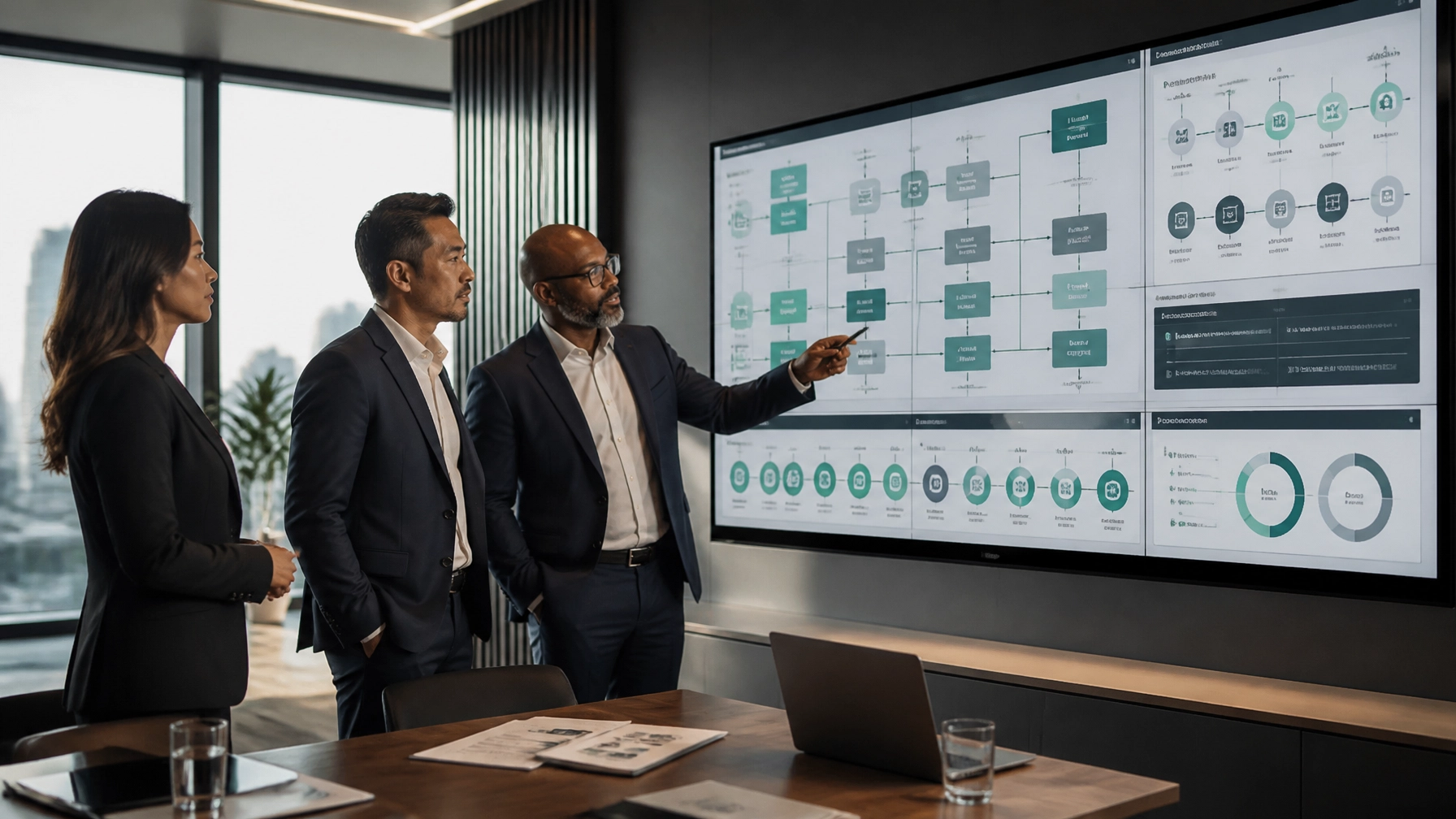
  • Untitled post 306

    Title: Software Implementation Lifecycle: Where Deals Are Won or Lost

    Meta description: Learn where high-ticket software implementation deals are won or lost: from executive education and discovery to selection, negotiation and delivery.

    Estimated reading time: 7 minutes
    Categories: B2B Acquisition, Software Implementation Sales Strategy, Pipeline Automation

    A high-ticket software implementation is not won when the contract is signed.

    It is won earlier: when the client defines the problem, agrees that change is necessary, establishes selection criteria and builds internal confidence that the project can be delivered.

    For implementation firms selling projects worth R500k or more, this pre-decision phase carries more commercial weight than most sales teams acknowledge. It determines:

    • Whether the opportunity becomes a funded project or dies as “no decision”
    • Whether your firm is evaluated on business outcomes or software features
    • Whether the deal supports healthy delivery margins
    • Whether your sales team spends time with serious buyers or unqualified demo requests
    • Whether the implementation begins with alignment or resistance

    The build and go-live phases are operationally critical. But the biggest competitive advantage is often created before either begins.

    The lifecycle has two parts

    Most teams think about the software implementation lifecycle as a delivery process:

    1. Planning
    2. Design
    3. Configuration or development
    4. Testing
    5. Deployment
    6. Support and optimisation

    That is the technical lifecycle. It begins after the client has already chosen a partner.

    The commercial lifecycle starts earlier:

    1. Account selection
    2. Qualification
    3. Business discovery
    4. Executive education
    5. Solution and implementation design
    6. Selection and commercial approval
    7. Delivery
    8. Value realisation and expansion

    The commercial lifecycle determines whether the delivery lifecycle exists at all.

    Enterprise software implementation lifecycle shown as a structured boardroom roadmap

    1. Account selection: choose opportunities you can actually win

    The first mistake is pursuing every company that appears interested in a new system.

    Interest is not a buying signal. A prospect may request a demonstration because they are researching options, responding to internal pressure or simply trying to understand what the market offers.

    A viable implementation opportunity needs more than software fit.

    Your team should establish whether the account has:

    • A defined operational or commercial problem
    • A credible reason to act now
    • Executive access or a realistic path to executive sponsorship
    • The financial capacity to fund a substantial implementation
    • Internal ownership of the problem
    • The willingness to change processes, data practices and accountability
    • A decision process that can be understood and influenced

    For a partner implementing Sage, SAP, Syspro, Acumatica or CRM platforms, this qualification discipline protects scarce resources. Senior salespeople and solution consultants should not be spending hours preparing demonstrations for companies that have no urgency, no budget owner and no internal mandate for change.

    The right account is not necessarily the largest account. It is the account where the business case, timing and decision structure make a successful project possible.

    2. Qualification: prove that the project is real

    Qualification should not be a formality before a demo. It should be a commercial control point.

    A qualified opportunity should have clear answers to questions such as:

    • What is failing in the current operating environment?
    • What is the cost of leaving the problem unresolved?
    • Which executive owns the outcome?
    • What event or business pressure is driving the decision?
    • What happens if the project is delayed by six or twelve months?
    • Who will be involved in selection?
    • How will the decision be funded?
    • What must be true for implementation to be considered successful?

    If these questions cannot be answered, the opportunity may not be ready for a sales meeting with your most expensive resources.

    This does not mean refusing to educate early-stage prospects. It means separating education from high-cost consulting. An automated education process can help prospects understand the implications of their current situation before your team commits to a detailed discovery process.

    That distinction is essential:

    • Education creates informed demand.
    • Qualification identifies commercial readiness.
    • Discovery determines whether your firm can win and deliver the project.

    3. Discovery: define the decision before presenting the solution

    Discovery is where many implementation firms lose control of the deal.

    They ask about features, modules and integrations before establishing the business problem. The resulting proposal may be technically accurate but commercially weak. It describes what the software does without proving why the client must change.

    Effective discovery operates across four dimensions.

    Business performance

    Understand the metrics affected by the current situation:

    • Delayed reporting
    • Excessive manual administration
    • Poor visibility across locations or departments
    • Revenue leakage
    • Slow order-to-cash cycles
    • Inaccurate forecasting
    • Compliance exposure
    • Customer service failures

    Technical environment

    Assess the constraints that will affect implementation:

    • Existing applications and integrations
    • Data quality
    • Security requirements
    • Reporting architecture
    • User access and permissions
    • Infrastructure
    • Migration complexity
    • Previous implementation failures

    Organisational readiness

    A system implementation changes responsibilities and working habits. Explore:

    • Who benefits from the change
    • Who may resist it
    • Which teams must adopt new processes
    • Whether leadership is aligned
    • How decisions will be made
    • What internal capacity exists for the project

    Financial impact

    Translate operational friction into business consequences.

    The goal is not to invent a return-on-investment figure. It is to identify the measurable levers that matter to the client:

    • Hours recovered
    • Errors reduced
    • Faster processing
    • Lower operating cost
    • Better working-capital control
    • Improved customer retention
    • Reduced risk
    • Faster management decision-making

    When discovery is done properly, the client’s selection criteria begin to reflect the way your firm understands the problem. That is a stronger position than entering a late-stage feature comparison.

    Sales and revenue operations leaders reviewing a qualified enterprise software pipeline dashboard

    4. Executive education: make the business case understandable

    Complex implementations are rarely approved because a buying committee enjoyed a demonstration.

    They are approved when executives understand:

    • Why the current state is commercially unacceptable
    • Why the problem requires a structural solution
    • Why the timing matters
    • What the implementation will involve
    • How risk will be controlled
    • How the investment connects to strategic outcomes

    This is the role of executive education.

    An effective executive briefing should not be a longer product presentation. It should give decision-makers a practical framework for evaluating the change. It should explain the problem, the financial implications, the implementation path and the risks of inaction.

    It should also provide internal champions with language they can use when presenting the project to finance, operations, IT and the board.

    For implementation firms, this creates a material advantage. You are no longer waiting for a prospect to arrive at your preferred conclusion after a generic demo. You are helping the buying group understand the decision on commercially relevant terms.

    5. Solution design: sell a safer path to value

    Once the problem is understood, the solution must be presented as an implementation path: not just a software configuration.

    A credible solution design should address:

    • Scope and priorities
    • Implementation phases
    • Client and partner responsibilities
    • Data and integration requirements
    • Change management
    • Governance and reporting
    • Key risks and mitigations
    • Success measures
    • Post-launch support
    • The route to measurable value

    This is where delivery expertise should enter the sales process.

    If implementation leaders only appear after the contract is signed, prospects may perceive a gap between the sales promise and the delivery reality. Bringing operational credibility into the decision phase reduces perceived risk and improves the quality of the eventual handover.

    It also helps protect margin. A clear implementation approach exposes complexity early, prevents avoidable scope assumptions and gives the commercial team a firmer basis for pricing.

    6. Selection and negotiation: do not wait for procurement to shape the deal

    By the time procurement becomes involved, the client should already understand the value case and the implementation requirements.

    If your firm has not helped shape those elements, the opportunity can quickly become a comparison based on:

    • Day rates
    • Feature checklists
    • Discount percentages
    • Generic references
    • Procurement compliance

    Price matters. But price becomes the dominant variable when business value and delivery risk have not been made specific.

    To remain commercially differentiated, equip your internal champion with:

    • A concise decision brief
    • A quantified problem statement
    • A phased implementation plan
    • Clear success criteria
    • Risk mitigation measures
    • Relevant proof of capability
    • A comparison based on business outcomes, not just features

    The objective is not to manipulate the process. It is to ensure that the decision reflects the full economic reality of the project.

    7. Delivery and go-live: fulfil the confidence you created

    Winning the deal is not the end of the lifecycle. A poorly delivered implementation destroys future referrals, expansion opportunities and market credibility.

    The delivery phase should validate the commitments made during the selection process through:

    • Clear governance
    • Documented ownership
    • Milestone discipline
    • Transparent issue management
    • User involvement
    • Structured testing
    • Practical training
    • Measurable adoption targets
    • Early value milestones

    Standard software development lifecycle models typically cover planning, design, implementation, testing, deployment and maintenance. Atlassian’s SDLC overview provides a useful technical reference for these stages.

    For implementation partners, however, the commercial lifecycle must connect to the technical one. The assumptions made during discovery affect scope. The quality of executive alignment affects adoption. The business case affects how success is measured.

    Delivery does not exist separately from sales. It is the continuation of the decision that was made.

    Implementation lead and client executives reviewing project milestones during a structured handover

    Where implementation firms lose margin

    The most common sources of commercial leakage are visible:

    • Demonstrations held before the prospect is qualified
    • Proposals issued without a quantified business problem
    • Single-threaded relationships with one contact
    • No confirmed decision process
    • Executive stakeholders introduced too late
    • Delivery teams excluded from solution design
    • Marketing reporting lead volume instead of pipeline quality
    • Sales stages based on activities rather than buyer progress

    These problems create a familiar pattern: a busy pipeline, full calendars and inconsistent revenue.

    The solution is not more activity. It is better control of the lifecycle.

    How to operationalise the pre-decision phase

    Your acquisition and sales system should reflect how complex buying decisions actually happen.

    Define pipeline stages around buyer progress:

    • Target account: fits the ideal customer profile
    • Qualified problem: business pain, urgency and ownership confirmed
    • Discovery: operational, technical, organisational and financial context documented
    • Executive alignment: decision-makers understand the case for change
    • Solution validation: implementation approach and success measures agreed
    • Commercial decision: process, budget and approval path confirmed
    • Won: delivery handover completed with assumptions documented

    Each stage should have exit criteria. An opportunity should not advance simply because a meeting occurred or a proposal was sent.

    This is also where automation becomes commercially useful. VRDStudio builds Automated B2B Acquisition Systems for high-ticket software implementers. These systems use targeted B2B traffic and Automated Executive Briefings to educate prospects, filter out unqualified demand and route warmer, better-informed executives into the CRM.

    The purpose is not to create more demonstrations.

    It is to create a Pre-Qualified Discovery Pipeline in which the sales team enters conversations with prospects who understand the problem, recognise the cost of delay and have a credible reason to evaluate a solution.

    The commercial conclusion

    For complex software implementations, the largest advantage is often won before configuration begins.

    The firm that controls the pre-decision phase can:

    • Shape how the client defines the problem
    • Influence the selection criteria
    • Build executive confidence
    • Reduce unproductive sales activity
    • Improve forecast quality
    • Protect implementation margins
    • Shorten the path from first engagement to funded project

    The implementation lifecycle does not begin at go-live.

    It begins when the buyer first decides that the current state is no longer acceptable: and your firm has the process to guide that decision.

    Ready to improve your implementation pipeline?

    Ready to stop wasting your top reps' time on unqualified demos? Register for the free webinar “The Death of the Free ERP Demo” at VRDStudio, or visit VRDStudio to learn more about building an Automated B2B Acquisition System.

  • Untitled post 303

    Meta Description: Stop wasting R400k/year on unqualified demos. Learn how Sage and SAP partners use automated discovery pipelines to triple win rates and shorten cycles.

    Estimated Reading Time: 6 minutes

    For Sage, SAP, and Syspro partners, the "Free Demo" has long been a staple of the sales process. It is also one of the most significant leaks in your firm’s profitability.

    When a Managing Director or Sales Director agrees to a demo without pre-qualification, they aren't just "showing the software." They are committing high-tier engineering resources and senior sales time to an unvetted lead. In the South African enterprise market: where high-ticket implementations (R500k+) carry long cycles: this approach is increasingly untenable.

    Leading implementers are abandoning the demo-first model in favor of Automated Discovery Pipelines. This shift isn't just about efficiency; it's about the cold, hard ROI of sales resource allocation.


    1. The R400k "Tire-Kicker" Salary Drain

    Most ERP firms calculate their marketing costs based on lead acquisition. They ignore the operational cost of sales.

    Consider the math:

    • Senior Sales Rep/Engineer Salary: R800,000 – R1.2M per year.
    • Time spent on an unqualified demo: 4–6 hours (Preparation, 90-minute demo, follow-up).
    • The "Tire-Kicker" Ratio: If 50% of your demos are with prospects who lack the budget, authority, or immediate need, your firm is burning roughly R400,000 per year per rep on dead-end opportunities.

    An Automated Discovery Pipeline acts as a high-tensile filter. It replaces the manual "discovery call" with an automated, on-demand Executive Briefing. This briefing educates the prospect on ROI and operational impact before a human ever steps into the room.

    Executive reviewing a lead qualification score on a tablet
    Alt Text: A professional executive reviewing lead qualification data on a tablet, symbolizing automated pre-qualification.


    2. ROI Drivers: Automated Discovery vs. Generic Demos

    The financial logic for automating your acquisition system is built on four primary levers:

    A. Win-Rate Uplift

    Generic demos focus on features (UI, modules, "the cloud"). Automated discovery pipelines focus on Business Case quantification.

    • Traditional: "Look at how easy our Sage Intacct dashboard is."
    • Automated Pipeline: "Here is how our implementation reduces your Order-to-Cash cycle by 14% based on your current volume."
    • Result: Win rates typically increase by 20–30% because the prospect sees a financial outcome, not just a software tool.

    B. Compressed Sales Cycles

    In high-ticket B2B software, the "stall" usually happens after the demo. The prospect "needs to think" or "discuss with the board."
    By using Automated Executive Briefings, you provide the board-level ROI data upfront. You front-load the objections and the financial justification, shortening the decision-making window by weeks.

    C. Increased Deal Velocity

    When your top-tier reps are only speaking to warm, budget-ready CEOs, their capacity to manage active deals triples. You don't need more reps; you need a more efficient system for the reps you have.


    3. The Structural Shift: Pipeline Automation

    VRDStudio builds these systems specifically for ERP implementers. We call it a Pre-Qualified Discovery Pipeline.

    How it operates:

    1. Targeted B2B Inbound: LinkedIn and Google traffic is funneled not to a "Contact Us" page, but to a structured ROI Briefing.
    2. The Automated Executive Briefing: A 15-minute high-value video that outlines the specific operational bottlenecks (e.g., inventory leakage in Syspro or multi-entity consolidation in Sage) and the ROI of your firm's specific implementation methodology.
    3. CRM Integration & Lead Scoring: Prospects are scored based on their engagement with the briefing. Only those who meet the "CEO-ready" threshold can book a slot on your sales calendar.

    Minimalist desk with open CRM dashboard
    Alt Text: A high-end office setup showing a modern CRM dashboard, representing automated sales pipeline management.


    4. Industry Nuances: Sage vs. SAP vs. Acumatica

    The bottleneck changes depending on the software you implement:

    • Sage Partners: Often struggle with "spreadsheet-reliant" firms that are price-sensitive. Your pipeline must focus on the cost of manual error and labor redundancy.
    • SAP/Acumatica Partners: Deal with complex, multi-stakeholder committees. Your automated discovery must provide "Board-Ready" documentation that the champion can use to sell the project internally.
    • Syspro Partners: Usually target manufacturing and distribution. Your pipeline needs to speak the language of inventory turns and supply chain resilience.

    By automating this discovery, you ensure that every person who hits your calendar has already been educated on your specific value proposition.

    Executives discussing operational strategy
    Alt Text: Senior executives discussing operational strategy, representing the high-level focus of an automated discovery pipeline.


    5. Eliminating Sales Friction

    "Friction" in an ERP sales cycle is usually caused by a lack of information.

    • Does the prospect understand the implementation timeline?
    • Do they understand the internal resource commitment required?
    • Do they understand the total cost of ownership (TCO)?

    A "Free Demo" rarely answers these questions. An Automated Discovery Pipeline does. It acts as a 24/7 salesperson that qualifies, educates, and pre-sells your expertise.

    VRDStudio Service Icons
    Alt Text: VRDStudio service icons showing Brand Engineering, UX design, Development, and Get Leads.


    The Verdict: Demos are for Tire-Kickers; Pipelines are for Closers

    If your sales team is spending more than 20% of their week on discovery calls that don't convert into proposals, your acquisition system is broken. You are subsidizing your prospects' education at the expense of your own margins.

    The move to Automated B2B Acquisition Systems is no longer a luxury for SAP and Sage partners: it is the baseline for operational survival in a competitive South African market.


    Ready to stop wasting your top reps' time on unqualified demos?

    Register for the free webinar: The Death of the Free ERP Demo — 22 July 2026

    Visit our website: VRDStudio

  • Untitled post 301

    Estimated Reading Time: 7 minutes

    For the Managing Director of an ERP implementation firm: whether you specialize in Sage, SAP, Syspro, or Acumatica: the most expensive resource in your building isn’t the server stack or the office rent. It is the time of your senior sales engineers and account executives.

    If your top-tier reps are spending 10 hours a week performing "free discovery demos" for companies with a R50k budget and a 2-year timeline, you are effectively burning over R400,000 per year in wasted salary and opportunity costs.

    To scale a high-ticket B2B software practice in South Africa, you must move away from manual filtering. You need an Automated B2B Acquisition System that connects your LinkedIn traffic directly to your CRM, ensuring that only pre-qualified, budget-ready CEOs ever reach your sales calendar.

    1. The Architecture: Connecting High-Intent Traffic to Your CRM

    Generic marketing focuses on "clicks." Operational acquisition focuses on data integrity and pipeline velocity. To automate your discovery pipeline, you need a three-tier architecture:

    1. The Traffic Source: LinkedIn B2B Ads (Lead Gen Forms or UTM-tracked landing pages).
    2. The Middleware: A bridge (like Zapier, Make, or native API connectors) that moves data in real-time.
    3. The CRM Layer: Your single source of truth (Salesforce, HubSpot, or Dynamics 365) configured with custom ERP qualification fields.

    By integrating these, you eliminate the "black hole" where leads sit in a CSV file for three days before a busy rep notices them. In the enterprise world, lead decay happens in hours, not days.

    A technical visualization of a data bridge connecting a LinkedIn interface with a professional CRM dashboard, showcasing a seamless flow of executive prospect data.

    2. Using LinkedIn Lead Gen Forms as a First-Pass Filter

    Most ERP firms make the mistake of asking for too little information. They fear "friction." However, for a R500k+ implementation, friction is your friend. It filters out the tire-kickers.

    When configuring LinkedIn Lead Gen Forms, move beyond name and email. Use custom questions to capture operational data:

    • Current ERP System: (e.g., "Legacy/Manual," "Sage 50," "Older SAP version").
    • Primary Industry: (Focus on your strengths, like Manufacturing, Distribution, or Mining).
    • Implementation Timeline: (e.g., "0-3 months," "3-6 months," "Just researching").
    • Company Size: Filter by employee count or revenue to ensure they can afford your service.

    Operational Tip: Use "Hidden Fields" in your forms to pass UTM parameters (Campaign Name, Ad Content) directly into your CRM. This allows you to track exactly which LinkedIn message is producing the highest ROI, not just the most leads.

    3. The Automated Executive Briefing: The Ultimate Qualification Tool

    Even a qualified lead isn't ready for a 1-on-1 demo yet. They need to be educated on your specific ROI framework first.

    At VRDStudio, we replace the traditional "Book a Call" button with an Automated Executive Briefing. This is an on-demand, high-level video presentation that:

    1. Identifies the specific bottlenecks in the prospect's industry (e.g., inventory leakage in Syspro environments).
    2. Demonstrates the financial impact of your implementation.
    3. Self-selects the prospect out if they aren't ready for the scale of your solution.

    By the time the data hits your CRM, the prospect has already consumed 15 minutes of your best sales logic. They are no longer a "lead"; they are an educated buyer.

    An executive briefing room with a high-definition screen showing enterprise software ROI data, symbolizing a professional pre-qualification process.

    4. Technical CRM Mapping: Automating the "Yes/No" Decision

    Once the LinkedIn data enters your CRM, your system should automatically score the lead based on your Ideal Customer Profile (ICP).

    The ERP Lead Scoring Matrix:

    • Industry Fit: +20 points for Manufacturing/Distribution; -50 points for Retail/SME.
    • Role Seniority: +15 points for MD/CEO/CFO; +5 points for IT Manager.
    • Current System: +25 points for "Legacy/Manual" (High pain point).
    • Timeline: +20 points for "0-3 months."

    If the score exceeds a specific threshold (e.g., 70 points), the system automatically triggers a task for your Sales Director and sends a calendar invite for a Discovery Call. If the score is low, the lead is funneled into an automated long-term nurture sequence, protecting your reps' calendars from low-value meetings.

    5. Eliminating the R400k/Year "Tire-Kicker" Drain

    The financial logic is simple. If your senior reps (earning R80k – R120k/month) spend 20% of their time on unqualified demos, you are losing significant capital.

    An integrated acquisition system ensures:

    • Zero Manual Entry: No more manual exporting of LinkedIn leads.
    • Instant Context: Your rep knows the prospect's industry, current ERP, and pain points before they pick up the phone.
    • Shortened Sales Cycles: Educated leads move through the pipeline 30-40% faster because the "discovery" was done by the system.

    A high-end South African manufacturing and distribution facility, representing the core target market for ERP implementation firms.

    Conclusion: Stop Selling, Start Qualifying

    The era of "spraying and praying" with generic LinkedIn ads is over. For Sage, SAP, and Syspro partners in South Africa, the competitive advantage lies in pipeline automation. By integrating LinkedIn traffic directly with your CRM and using an Automated Executive Briefing to filter intent, you transform your sales department from a cost center into a high-velocity acquisition engine.

    Register for the free webinar: The Death of the Free ERP Demo — 22 July 2026

    Visit our website: VRDStudio