
Reading Time: 9 Minutes
For the Managing Director of an ERP implementation firm, the sales cycle is often a war of attrition. You are selling complex, R500k+ enterprise solutions (Sage, SAP, Syspro, Acumatica) to a skeptical audience of CEOs and Operations Directors. These decision-makers don't care about "seamless integration" or "user-friendly interfaces": they care about operational friction and leaked capital.
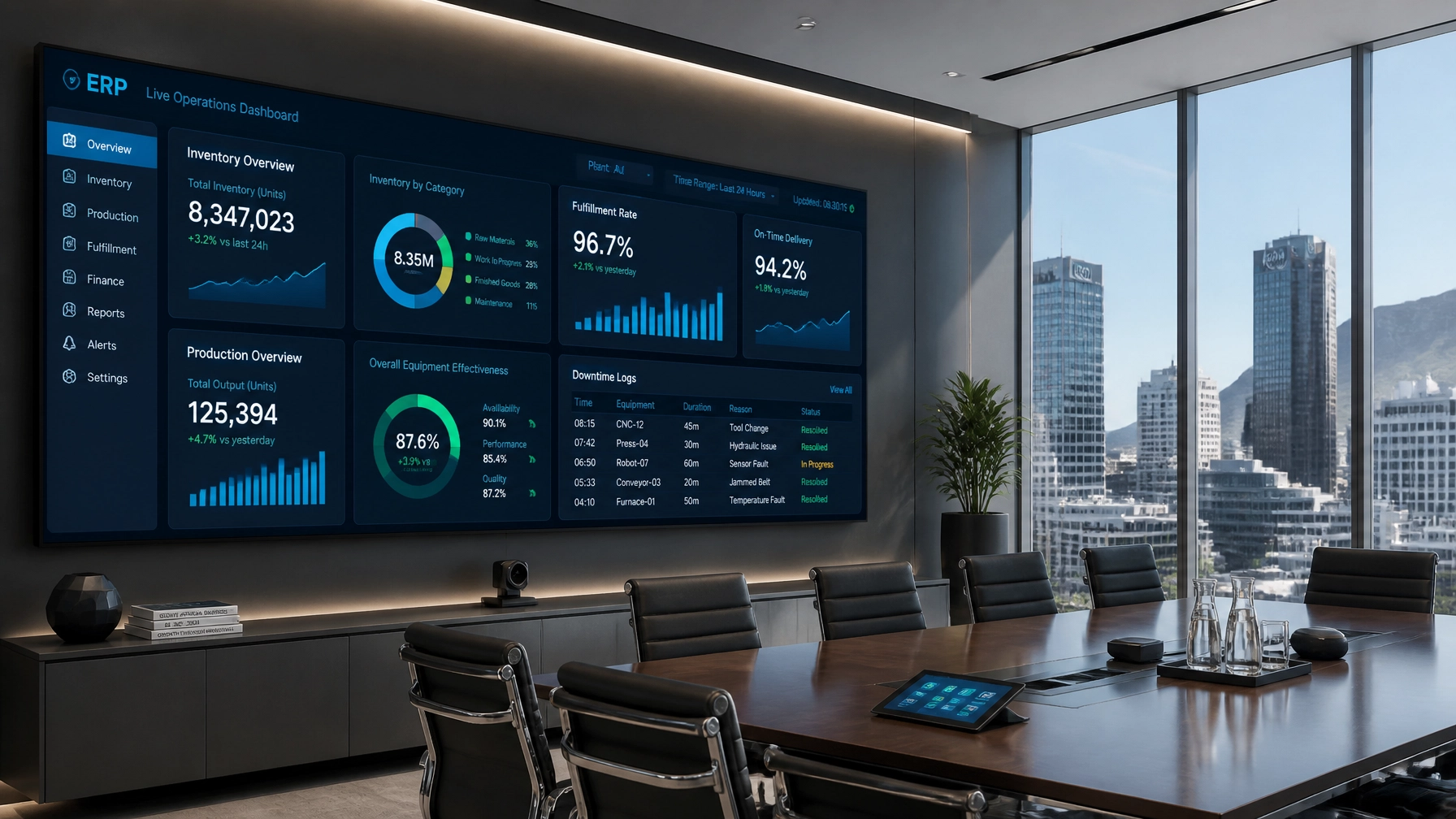
The most powerful sales asset you possess isn’t your slide deck; it is the operational data sitting inside your past successful implementations. By mining specific metrics: inventory variance, fulfillment cycle times, and QA defect rates: you can transition from a "software vendor" to a strategic partner that solves measurable business pain.
We call this Strategic Pain-Mapping.
1. The Data Goldmine: Beyond Implementation Logs
Most implementation firms treat their post-go-live data as a technical confirmation of project success. However, for your sales and acquisition strategy, this data is the "Proof of Concept" that converts cold prospects into high-intent leads.
When you can point to a specific South African manufacturing client and show that an ERP implementation reduced their inventory variance from 12% to 0.5% within six months, you are no longer selling software. You are selling a recovered 11.5% of their working capital.
Why Operational Data Beats Marketing Fluff:
- Logical Validation: CEOs of mid-market firms are inherently skeptical of "transformation" claims. They respond to specific, industry-standard KPIs.
- Authority Building: Demonstrating knowledge of localized fulfillment challenges (e.g., South African logistics bottlenecks or Eskom-related production downtime) positions you as an expert in their specific environment.
- Reduced Sales Friction: When a prospect sees data that mirrors their own internal "red flags," the discovery call shifts from "Why should I buy this?" to "How quickly can we fix this?"
2. Mining the Operational "Pain": 4 Metrics That Sell
To build a high-authority B2B acquisition system, you must categorize your content around the specific operational failures that keep CEOs awake at night.

A. Inventory Accuracy Rates (The "Missing Money" Angle)
Inventory variance is a silent killer of cash flow. If a prospect's current system shows 1,000 units but the warehouse only has 850, they are losing money on sales they can't fulfill and taxes on stock they don't have.
- Sales Strategy: Use your implementation data to show the correlation between real-time scanning and SKU-level accuracy.
- The Insight: High-ticket software is the only way to eliminate the "paper-and-spreadsheet" lag that causes these discrepancies.
B. Fulfillment Cycle Times (The "Customer Churn" Angle)
In the South African distribution sector, fulfillment speed is a primary competitive advantage. If a client’s ERP takes 48 hours to move an order from "Approved" to "Picked," they are already behind.
- Sales Strategy: Map the reduction in "order-to-cash" cycles across your SAP or Sage projects.
- The Insight: Shortening a cycle by 24 hours often pays for the software implementation within the first year through increased throughput.
C. QA Defect Rates (The "Brand Erosion" Angle)
For manufacturing firms, quality assurance isn't just about compliance; it's about avoiding catastrophic product recalls and contract penalties.
- Sales Strategy: Highlight how your ERP's QA module captures failure reasons in real-time, preventing defective batches from leaving the floor.
- The Insight: Use automated briefings to show how integrated QA data reduces RMA (Return Merchandise Authorization) costs by a quantifiable percentage.
D. Production Downtime Logs (The "Operations Black Hole")
Unplanned downtime is the single largest drain on manufacturing ROI.
- Sales Strategy: Mine your data for "Mean Time Between Failures" (MTBF) improvements after implementing predictive maintenance modules.
- The Insight: Addressing downtime via ERP automation is an operational win that speaks directly to a Managing Director’s bottom line.
3. The Pivot: From Features to Friction Removal
Traditional marketing for ERP partners focuses on features: "Cloud-based," "Mobile-enabled," or "AI-driven." This is a mistake. High-ticket buyers are looking to remove friction, not add features.
Stop Selling "Software"
When you communicate with a CEO, you must frame your solution as an Automated B2B Acquisition System for their operations. You aren't giving them a new UI; you are giving them a "Pre-Qualified Discovery Pipeline" for their internal data.
Start Selling "Systemic Control"
By mapping pain points directly to the data fields in your ERP (e.g., linking Syspro’s Landed Cost Tracking to a prospect's struggle with import volatility), you demonstrate that you understand their business at a granular, operational level.
4. Automating the Acquisition: The Executive Briefing
Mining this data is only half the battle. The other half is getting this insight in front of the right decision-makers without burning your sales team’s time on unqualified tire-kickers.

At VRDStudio, we help ERP implementers build Automated Executive Briefings. Instead of a generic "demo," we create high-value video assets that walk a CEO through the exact "Pain-Mapping" discussed above.
How the System Works:
- Targeted B2B Traffic: We use LinkedIn and Google to target CEOs and MDs of firms currently facing operational friction.
- The Automated Briefing: Instead of a sales call, the prospect watches an on-demand briefing that uses your operational data to prove ROI.
- Filtration: Only prospects who confirm they have the specific "pain" (e.g., >10% inventory variance) are allowed to book a call.
- CRM Integration: These warm, budget-ready CEOs are dropped directly into your sales calendar, pre-educated on your system's value.
5. Turning Data into a Competitive Moat
Your competitors are out there talking about "digital transformation." While they use vague terminology, you can use Strategic Pain-Mapping to talk about "reducing fulfillment lag by 18%."

This level of operational specificity builds immediate trust. It shows that you aren't just an IT shop: you are an operational consultancy that uses enterprise software as a tool to drive profit.
If your firm is currently relying on word-of-mouth or generic "leads" that never turn into R500k+ implementations, it’s time to change your acquisition strategy. Stop selling the "what" and start selling the "how much it's costing you not to have this."
Conclusion: Automate Your Pipeline Today
Relying on traditional demos and "hope-based" marketing is a recipe for stagnant growth and wasted sales resources. By leveraging your existing ERP implementation data, you can build a pipeline that self-filters and converts at a higher rate.

Ready to stop wasting your top reps' time on unqualified demos? Register for our free webinar 'The Death of the Free ERP Demo' on 22 July at VRDStudio or visit VRDStudio to learn more.